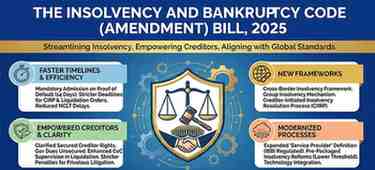
India’s Most Comprehensive Insolvency Reform Since 2016
Executive Summary
The Insolvency and Bankruptcy Code (Amendment) Bill, 2025 represents the most significant overhaul of India’s insolvency framework since the original Code was enacted in 2016. Introduced by Finance Minister Nirmala Sitharaman in the Lok Sabha on August 12, 2025, this comprehensive reform aims to address procedural delays, reduce judicial discretion, enhance creditor rights, and introduce modern concepts like creditor-initiated resolution processes, group insolvency, and cross-border insolvency frameworks.
The Bill is the culmination of three years of stakeholder consultations and builds upon recommendations from multiple Insolvency Law Committees. It seeks to restore the Code’s core principles of clarity, speed, and commercial certainty while adapting to the evolving needs of India’s financial ecosystem.
Background and Context
The Insolvency and Bankruptcy Code, 2016 (IBC) was enacted to provide a time-bound process for resolving insolvency among companies and individuals. Since its implementation in December 2016, the Code has processed thousands of cases and has been instrumental in improving India’s ease of doing business rankings. However, practical challenges have emerged over the years.
As of June 2025, 8,492 Corporate Insolvency Resolution Process (CIRP) cases have been admitted under the Code. Of these, 1,905 cases remain ongoing, while the rest have been closed through resolution or liquidation. While the Code has achieved significant success, stakeholders have identified several areas requiring improvement, including procedural delays in admission of cases, erosion of asset value during prolonged proceedings, ambiguities arising from judicial interpretations, and inadequate frameworks for complex scenarios like group insolvency and cross-border insolvency.
What is the Insolvency and Bankruptcy Code?
The Insolvency and Bankruptcy Code (IBC) is a comprehensive law that consolidates all insolvency and bankruptcy proceedings in India. When a company defaults on its debt obligations, creditors can initiate a CIRP to either revive the company through a resolution plan or liquidate it if revival is not possible. The entire process is overseen by the National Company Law Tribunal (NCLT), and a Committee of Creditors (CoC) comprising financial creditors makes key decisions regarding the company’s fate.
Key Objectives of the Amendment Bill
The Amendment Bill has been designed with several critical objectives that address the practical challenges observed during the implementation of the original Code:
⚡ Faster Resolution
Mandating strict timelines for admission of insolvency applications and completion of proceedings to prevent value erosion.
⚖️ Reduced Litigation
Clarifying ambiguous provisions and removing judicial discretion in areas where it has led to unnecessary disputes.
💪 Creditor Empowerment
Enhancing the role of the Committee of Creditors in both resolution and liquidation processes.
🔄 Alternative Mechanisms
Introducing the Creditor-Initiated Insolvency Resolution Process (CIIRP) for out-of-court resolutions.
🌐 Global Alignment
Establishing frameworks for group insolvency and cross-border insolvency aligned with international best practices.
🎯 Clarity and Certainty
Addressing judicial interpretations that have created unintended consequences and operational uncertainties.
Major Amendments to Corporate Insolvency Resolution Process (CIRP)
1. Strict Timelines for Admission of Applications
One of the most significant changes is the introduction of mandatory timelines for the admission or rejection of insolvency applications. The Bill amends Sections 7, 9, and 10 of the Code to mandate that the NCLT must decide on applications within 14 days from the date of filing.
Grounds for Admission/Rejection
The NCLT must admit an application if:
- Default is established: The debt and default are clearly proven, with records from Information Utilities serving as sufficient evidence
- Application is complete: All required documents and information are provided
- No disciplinary proceedings: The proposed Interim Resolution Professional (IRP) is not facing any disciplinary action
If the NCLT fails to decide within 14 days, it must record reasons in writing for the delay. Applications with defects must be given 7 days for rectification.
Addressing the Vidarbha Industries Judgment
This amendment directly addresses the Supreme Court’s decision in Vidarbha Industries Power Ltd. v. Axis Bank Ltd., which had given the NCLT broad discretion to decide whether to admit an insolvency application. This discretion led to significant delays and inconsistent decisions. The new provisions eliminate this discretion, making admission almost automatic once the specified conditions are met.
2. Enhanced Role of Information Utilities
The Bill clarifies that records of default from Information Utilities constitute sufficient proof of debt and default. This reduces the burden of proof on applicants and speeds up the admission process. Information Utilities are repositories of financial information that maintain authenticated records of debt and default, and the amendment strengthens their role in the insolvency ecosystem.
3. Appointment of Interim Resolution Professional
Previously, companies filing for voluntary insolvency under Section 10 had to nominate an IRP. The Bill removes this requirement. Now, if no IRP is nominated or if the nominated person is ineligible, the NCLT will seek recommendations from the IBBI, which regulates insolvency professionals.
4. Restrictions on Withdrawal of Applications
The Bill tightens the provisions for withdrawing admitted insolvency applications. Currently, under certain regulations, applications could be withdrawn before the constitution of the Committee of Creditors. The proposed amendment requires that once an application is admitted, it can only be withdrawn with the approval of the Committee of Creditors, even if the CoC has not yet been constituted.
Rationale Behind This Change
This amendment responds to situations like the Supreme Court case involving GLAS Trust Company LLC v. Byju Raveendran, where the Board of Control for Cricket in India attempted to withdraw an insolvency application after admission but before CoC constitution. Such withdrawals can be used strategically to pressure debtors into settling, which may not align with the interests of all creditors.
5. Expanded Role of Persons Assisting the IRP
Section 19 has been amended to broaden the scope from only “personnel” (employees) to “persons,” which now includes:
- Current and former employees
- Management and associates
- Contractual service providers
- Promoters
All these persons are now mandated to extend assistance and cooperation to the IRP in managing the corporate debtor’s affairs. This ensures that the IRP has access to all necessary information and support to conduct the insolvency process effectively.
Creditor-Initiated Insolvency Resolution Process (CIIRP)
One of the most innovative features of the Amendment Bill is the introduction of the Creditor-Initiated Insolvency Resolution Process (CIIRP), an alternative to the traditional CIRP that allows for out-of-court commencement of insolvency proceedings.
How CIIRP Works
CIIRP Process Flow
1
Initiation: At least 51% of notified financial creditors (by value of debt) must agree to initiate CIIRP
2
Notice: A notice is sent to the corporate debtor giving them 30 days to respond
3
Public Announcement: If uncontested, CIIRP begins with a public announcement
4
Debtor-in-Possession: The Board of Directors remains in control under supervision of the Resolution Professional
5
Moratorium: Can be sought if approved by 51% of creditors to prevent other legal actions
6
Timeline: Must be completed within 150 days, extendable by 45 days
7
Conversion: Can be converted to regular CIRP at any time by CoC decision or if debtor doesn’t cooperate
Key Features of CIIRP
Distinctive Characteristics:
- Limited Initiation: Only specified financial institutions (notified by the government) can initiate CIIRP
- Debtor-in-Possession Model: Unlike CIRP where control shifts to the Resolution Professional, in CIIRP the existing management retains control under RP supervision
- Out-of-Court Process: Reduces judicial involvement, potentially speeding up resolution
- Voluntary Element: Requires majority creditor consent, making it more collaborative
- Flexibility: Can convert to CIRP if the process faces obstacles or non-cooperation
Potential Concerns with CIIRP
While CIIRP introduces much-needed flexibility, some concerns have been raised:
- Priority for certain creditors: Only specified financial institutions can initiate CIIRP, potentially creating a hierarchy among creditors
- Risk of premature CIRP: Other creditors might initiate traditional CIRP before CIIRP can be effective
- Default as trigger: Since default is still the trigger, it may not always serve the objective of maximizing value when early intervention could be more beneficial
- Operational creditor exclusion: Operational creditors (suppliers, vendors) are completely excluded from initiating CIIRP
Revolutionary Changes to Liquidation Process
1. Committee of Creditors’ Enhanced Role
The Bill fundamentally changes the liquidation process by extending the role of the Committee of Creditors from CIRP into liquidation. Previously, once liquidation was ordered, the liquidator operated with significant independence. Now:
CoC Powers in Liquidation:
- Appointment Authority: The liquidator is appointed on the proposal of the CoC
- Removal Powers: The CoC can replace the liquidator during the process with 66% member approval
- Supervisory Role: The CoC supervises the conduct of the entire liquidation process
- Decision Making: Key decisions regarding asset sales and distributions require CoC approval
2. Streamlined Claims Process
In a significant change, the Bill removes the liquidator’s power to verify, admit, or reject claims and determine the value of admitted claims. This administrative burden is lifted, allowing the liquidator to focus on asset realization and distribution. The claims verification process will be handled differently, though detailed procedures are expected to be specified in regulations.
3. Reduced Timeline for Liquidation
Section 54 is revised to impose stricter timelines for completing the liquidation process, preventing indefinite proceedings and ensuring faster closure of insolvent entities.
Treatment of Security Interests and Guarantor Assets
Clarification on Security Interest Definition
The Bill clarifies the definition of “security interest” to distinguish between:
- Consensual securities: Mortgages, pledges, hypothecation created by agreement
- Non-consensual, statutory liens: Claims by government authorities for statutory dues
Critical Clarification: Statutory Dues Are Not Secured Creditors
The Bill explicitly clarifies that statutory dues (like tax arrears) do not have the status of secured creditors. This resolves ambiguity that had led to significant litigation. Statutory authorities will be treated as unsecured creditors in the liquidation waterfall, which could impact revenue recovery for government entities but provides clarity to the process.
Transfer of Guarantor Assets
Section 28A is proposed to be amended to allow creditors who have taken possession of a guarantor’s assets to transfer or sell those assets during the corporate debtor’s CIRP or liquidation. The key provisions include:
- Sale requires approval from the corporate debtor’s Committee of Creditors
- If the guarantor is also undergoing insolvency proceedings, approval from the guarantor’s CoC is also required (except during liquidation if the creditor hasn’t relinquished the asset)
- Sale proceeds form part of the corporate debtor’s resolution or liquidation estate
This provision enables better asset realization by allowing secured creditors to monetize guarantor assets that are available to them, increasing the pool of funds available for distribution to all creditors.
Liquidation Waterfall and Priority Clarifications
The Bill adds illustrations to Section 53, which prescribes the order of priority for distributing liquidation proceeds. These illustrations clarify:
What Contractual Arrangements Will Be Disregarded:
- Contracts between workmen and secured creditors that give secured creditors priority over workmen’s dues
- Any agreement that attempts to alter the statutory waterfall to the detriment of higher-priority claimants
What Contractual Arrangements Will Be Permitted:
- Contracts among creditors of the same class determining inter se priorities (for example, agreements between multiple secured creditors about their respective shares)
Liquidation Waterfall (Order of Priority):
- Insolvency resolution process costs and liquidation costs
- Workmen’s dues for 24 months preceding liquidation
- Debts owed to secured creditors (to the extent of their security interest)
- Wages and unpaid dues to employees (other than workmen) for 12 months
- Financial debts owed to unsecured creditors
- Operational debts (trade creditors, suppliers)
- Government dues (taxes and statutory payments)
- Remaining debts and dues
- Preference shareholders
- Equity shareholders or partners
Preferential, Undervalued, Fraudulent, and Extortionate (PUFE) Transactions
The Bill makes important amendments to how transactions are examined for being preferential, undervalued, fraudulent, or extortionate. Section 43 is amended to change the look-back period for identifying PUFE transactions.
| Aspect |
Current Provision |
Proposed Amendment |
| Reference Date |
Insolvency Commencement Date (date when CIRP is admitted by NCLT) |
Initiation Date (date when application is filed with NCLT) |
| Look-back Period for Related Parties |
4 years before Commencement Date |
4 years before Initiation Date |
| Look-back Period for Unrelated Parties |
2 years before Commencement Date |
2 years before Initiation Date |
| Practical Impact |
Shorter actual period due to admission delays |
Longer actual period, more transactions can be examined |
This change is significant because applications often take months to be admitted. By moving the reference date to the filing date rather than the admission date, the Bill ensures that the full intended look-back period is available for scrutiny of suspicious transactions. This prevents debtors from using the admission delay period to their advantage by conducting transactions that would otherwise be scrutinized.
Minimum Payment for Dissenting Creditors
Section 30 is amended to provide explicit protection for dissenting financial creditors (those who vote against a resolution plan). The amendment mandates that dissenting creditors must receive:
The lower of:
- The liquidation value (what they would receive if the company were liquidated), OR
- What they would receive if the resolution plan proceeds were distributed according to the Section 53 waterfall
This ensures that minority creditors cannot be forced to accept a resolution plan that gives them less than what they would receive in liquidation, providing an important safeguard against potential abuse by majority creditors.
Group Insolvency Framework
The Bill introduces enabling provisions for group insolvency, recognizing that modern corporate structures often involve multiple interconnected entities within the same corporate group. The framework allows for:
Key Features of Group Insolvency:
- Joint Creditor Committees: A single CoC can be constituted for multiple group companies undergoing insolvency
- Common Insolvency Professional: One Resolution Professional can handle the insolvency proceedings of multiple group entities
- Joint Hearings: The NCLT can conduct joint hearings for related group companies before a single bench
- Coordinated Resolution: Enables holistic resolution that considers the interdependencies between group entities
- Consolidated Plans: Allows for resolution plans that address the entire group rather than individual entities in isolation
The detailed rules and procedures for group insolvency will be framed by the central government. This framework is particularly important for addressing situations where value exists at the group level but individual entities may not be viable standalone businesses.
Benefits of Group Insolvency:
- Value Maximization: Prevents value destruction from piecemeal liquidation of interconnected entities
- Efficiency: Reduces duplication of processes and costs across multiple proceedings
- Holistic View: Allows creditors and insolvency professionals to see the complete picture
- Prevents Strategic Manipulation: Reduces ability of promoters to strategically structure group entities to defeat creditor claims
Cross-Border Insolvency Provisions
The Bill empowers the central government to frame rules for cross-border insolvency, moving beyond the current bilateral arrangement provisions. New Sections 240B and 240C are proposed to be added:
Section 240B: Electronic Portal
The government is empowered to establish an electronic portal to streamline procedures related to insolvency and bankruptcy processes, including cross-border matters. This digital infrastructure will facilitate information sharing, document filing, and coordination with foreign jurisdictions.
Section 240C: Cross-Border Insolvency Framework
This section empowers the central government to:
- Frame comprehensive rules for cross-border insolvency proceedings
- Designate special benches of the NCLT to handle cross-border cases
- Adapt other laws as necessary to accommodate cross-border insolvency
- Potentially align with the UNCITRAL Model Law on Cross-Border Insolvency
Why Cross-Border Insolvency Matters:
In today’s globalized economy, many Indian companies have assets, operations, and creditors in multiple countries. Similarly, foreign companies with operations in India may face insolvency. A robust cross-border insolvency framework enables:
- Recognition of foreign insolvency proceedings in India
- Recognition of Indian insolvency proceedings abroad
- Coordination between insolvency professionals across jurisdictions
- Protection of assets from being dissipated across borders
- Fair treatment of foreign creditors in Indian proceedings and vice versa
Personal Insolvency and Bankruptcy Amendments
The Bill also makes significant changes to provisions relating to personal insolvency and bankruptcy (applicable to individuals and partnership firms):
No Interim Moratorium for Personal Guarantors
Sections 96 and 124 are amended to clarify that interim moratorium provisions do not apply to personal guarantors during resolution and bankruptcy proceedings. This means:
- Personal guarantors cannot escape liability by claiming moratorium protection
- Creditors can proceed against personal guarantors even when the corporate debtor is undergoing CIRP
- This prevents abuse where promoters who have given personal guarantees try to use insolvency proceedings to evade their guarantee obligations
Simplified Bankruptcy Process
The amendments streamline the personal bankruptcy process, making it faster and clearer. If a debtor fails to file a repayment plan within the specified time, bankruptcy proceedings can be initiated directly, preventing indefinite delays.
Enhanced Powers of IBBI
The Insolvency and Bankruptcy Board of India (IBBI), which regulates insolvency professionals and agencies, receives expanded powers under the Bill:
Regulatory Authority
Enhanced ability to regulate service providers, including Insolvency Professional Agencies and Information Utilities
CoC Oversight
Power to monitor and regulate the conduct of Committee of Creditors members
Penalty Powers
Ability to impose penalties for non-compliance and misconduct
Suspension Authority
Power to suspend registrations of insolvency professionals pending investigations
Mandatory Data Filing for Operational Creditors
The Bill introduces a requirement for operational creditors to file debt data with Information Utilities. Even if the corporate debtor does not authenticate this data, it will be deemed valid for the purpose of initiating insolvency proceedings. This:
- Empowers operational creditors (suppliers, vendors, service providers) who often face difficulty proving debt
- Reduces the corporate debtor’s ability to delay proceedings by refusing to authenticate debt records
- Creates a more comprehensive database of corporate debt in the economy
Impact on Different Stakeholders
📊 Financial Creditors (Banks, Financial Institutions)
- Faster Resolution: Strict admission timelines reduce delays in recovering dues
- Enhanced Control: Greater role in liquidation through CoC supervision
- CIIRP Option: New out-of-court mechanism for quicker resolution with debtor cooperation
- Better Protection: Minimum payment guarantees for dissenting creditors
- Concerns: CIIRP limited to specified institutions may create two-tier system
🏭 Operational Creditors (Suppliers, Vendors)
- Easier Proof of Debt: Mandatory filing with Information Utilities helps establish claims
- Faster Admission: 14-day admission timeline benefits all creditor classes
- Concerns: Excluded from initiating CIIRP; remains only CIRP option
- Impact of Statutory Dues Clarification: Government moving down in priority may leave more for operational creditors
🏢 Corporate Debtors
- CIIRP Opportunity: Debtor-in-possession model allows management to remain in control during resolution
- Faster Process: Quicker admission and resolution means less uncertainty
- Stricter Scrutiny: Expanded PUFE look-back period and tighter withdrawal provisions reduce room for strategic maneuvering
- Group Resolution: Framework for coordinated resolution of group entities may preserve more value
⚖️ Insolvency Professionals
- Clearer Framework: Reduced ambiguity makes their role more straightforward
- Expanded Cooperation: Broader definition of “persons” who must assist them
- Liquidation Changes: Reduced burden of claims verification; more supervision by CoC
- New Opportunities: Group insolvency and CIIRP create new professional services areas
- Greater Accountability: Enhanced IBBI powers mean stricter oversight
🏛️ Government and Regulatory Authorities
- Statutory Dues: Explicit clarification that government dues are unsecured may impact revenue recovery
- Reprioritization: Government claims now clearly subordinate to secured creditors and certain employee dues
- Administrative Benefits: Clearer processes reduce burden on tribunals
- Policy Tools: Flexibility to frame rules for group insolvency, cross-border insolvency, and CIIRP
👥 Employees and Workmen
- Priority Protection: Clarifications in liquidation waterfall reinforce their high priority status
- Contractual Safeguards: Contracts that attempt to subordinate workmen’s dues will be disregarded
- Faster Resolution: Quicker processes mean less uncertainty about employment status
Potential Challenges and Considerations
Implementation Challenges
- Capacity Constraints: The 14-day admission timeline requires NCLTs to significantly increase their processing capacity. Without adequate judges and infrastructure, this mandate may be difficult to meet.
- Rule-Making Delays: Many provisions depend on detailed rules to be framed by the government (group insolvency, cross-border insolvency, CIIRP specifications). Delays in rule-making could limit the effectiveness of the reforms.
- CIIRP Operationalization: The success of CIIRP depends on which financial creditors are “notified” and how they cooperate. If only a few institutions are eligible, it may not achieve its potential.
- Transition Period: Existing cases will need clarity on whether new provisions apply retroactively or only prospectively.
- Stakeholder Resistance: Some changes may face resistance from stakeholders who benefited from ambiguities in the current law.
Timeline and Current Status
Legislative Journey
1
August 12, 2025 – Bill Introduction
Finance Minister Nirmala Sitharaman introduced the Insolvency and Bankruptcy Code (Amendment) Bill, 2025 in the Lok Sabha as Bill No. 107 of 2025.
2
August 2025 – Committee Referral
The Bill was referred to a Select Committee of Parliament for detailed examination and stakeholder consultation.
3
November 2025 (Expected) – Committee Report
The Select Committee is expected to submit its report before the Winter Session of Parliament, which typically begins in late November.
4
Winter Session 2025 (Expected) – Parliamentary Approval
Following the Committee’s report, the Bill will be tabled in Parliament for debate and approval by both Houses.
5
2026 (Expected) – Implementation
Once passed and notified, the amendments will come into effect. Some provisions may be implemented in phases, with detailed rules to be framed by the government and IBBI.
Comparison: Current IBC vs. Proposed Amendments
| Aspect |
Current IBC (2016) |
Proposed Amendments (2025) |
| Admission Timeline |
No strict timeline; significant delays common |
Mandatory 14 days; written reasons required for delay |
| Judicial Discretion |
Broad discretion to admit/reject applications |
Minimal discretion; admission mandatory if criteria met |
| Application Withdrawal |
Can be withdrawn before CoC constitution under certain regulations |
Requires CoC approval even before CoC constitution |
| Liquidation Oversight |
Liquidator operates largely independently |
CoC supervises liquidation; can appoint/remove liquidator |
| Statutory Dues |
Ambiguous; some courts treated as secured |
Explicitly clarified as unsecured |
| Resolution Alternatives |
Only CIRP available |
CIIRP introduced for out-of-court resolution |
| Group Insolvency |
No framework; each entity separate |
Coordinated framework with joint CoC, common RP |
| Cross-Border |
Limited bilateral arrangements |
Comprehensive framework aligned with UNCITRAL principles |
| PUFE Look-back |
From insolvency commencement date |
From application initiation date (longer effective period) |
| Personal Guarantors |
Some ambiguity on moratorium applicability |
Clearly excluded from moratorium protection |
| Dissenting Creditor Protection |
General fairness principles |
Explicit minimum payment formula |
| Information Utilities |
Limited role; evidentiary value unclear |
Records constitute sufficient proof of default |
Global Perspective and Best Practices
The amendments align India’s insolvency framework with international best practices observed in mature economies:
Alignment with UNCITRAL Model Law
The proposed cross-border insolvency provisions move India toward alignment with the UNCITRAL Model Law on Cross-Border Insolvency, which has been adopted by over 40 countries. This will facilitate international cooperation in insolvency matters and make India a more attractive destination for international business.
Debtor-in-Possession Models
CIIRP’s debtor-in-possession approach is similar to Chapter 11 proceedings in the United States, where management continues to run the company while developing a reorganization plan. This model has proven effective for viable companies facing temporary financial distress.
Group Insolvency Frameworks
The group insolvency provisions draw from frameworks in jurisdictions like the UK, Singapore, and the EU, which have developed sophisticated mechanisms for handling enterprise groups in insolvency.
Creditor Governance
The enhanced role of the Committee of Creditors, particularly in liquidation, reflects international practice where creditor committees play a central role in insolvency proceedings, balancing the powers of insolvency practitioners.
Conclusion: A New Era for Indian Insolvency Law
The Insolvency and Bankruptcy Code (Amendment) Bill, 2025 represents a watershed moment in the evolution of India’s insolvency regime. By addressing the practical challenges that have emerged over eight years of implementation, the Bill promises to make the insolvency process faster, more predictable, and more effective at achieving its core objective: maximizing value for all stakeholders.
Key Takeaways
The amendments introduce a multi-pronged approach to improving the insolvency ecosystem. By mandating strict timelines, the Bill tackles the problem of delayed admission that has plagued many cases. By clarifying ambiguous provisions, particularly around statutory dues and security interests, it reduces litigation and provides certainty. By introducing CIIRP, it offers flexibility and an out-of-court alternative that may better serve viable companies. By enabling group and cross-border insolvency frameworks, it recognizes the reality of modern corporate structures and globalized business.
For creditors, particularly financial institutions, the amendments offer stronger protections and greater control over the process. The enhanced role of the Committee of Creditors in liquidation, the clarification that statutory dues are unsecured, and the minimum payment guarantees for dissenting creditors all strengthen creditor rights. The CIIRP option provides a potentially faster and less adversarial path to resolution.
For corporate debtors, the amendments create both opportunities and constraints. The debtor-in-possession model in CIIRP allows management to remain in control while resolving financial distress. However, stricter timelines, expanded PUFE scrutiny, and tighter withdrawal provisions reduce the ability to use procedural delays strategically. Overall, the message is clear: genuine resolution is encouraged, but gaming the system will be harder.
For insolvency professionals, the amendments provide much-needed clarity but also impose greater accountability. The expanded IBBI powers mean higher professional standards will be expected and enforced. The introduction of group insolvency and CIIRP creates new areas of practice requiring specialized expertise.
For the broader economy, an efficient insolvency regime is crucial for credit availability, investor confidence, and business dynamism. By making outcomes more predictable and processes faster, these amendments should improve India’s business climate and credit culture. When lenders have confidence they can recover dues efficiently through the insolvency system, they are more willing to lend. When businesses know financial distress can be resolved rather than leading to destruction, entrepreneurship is encouraged.
Looking Ahead
The success of these ambitious reforms will depend on implementation. The government must move quickly to frame detailed rules for CIIRP, group insolvency, and cross-border insolvency. The NCLT system needs significant capacity building to meet the 14-day admission mandate. The IBBI must develop robust frameworks for regulating the new processes and maintaining professional standards.
Stakeholders should prepare for the changes by understanding the new provisions, adapting internal processes, and training personnel. Legal and financial professionals should deepen their expertise in the new areas introduced by the Bill. Courts and tribunals will need to approach the new provisions with a mindset of commercial pragmatism rather than excessive formalism.
Most importantly, all stakeholders must embrace the spirit of the reforms, not just the letter. The amendments aim to create a resolution-oriented culture rather than a liquidation-oriented one, to promote cooperation rather than confrontation, and to achieve speed without sacrificing fairness. If implemented effectively and embraced genuinely, the Insolvency and Bankruptcy Code (Amendment) Bill, 2025 can transform India’s approach to corporate distress and establish India as a jurisdiction with a world-class insolvency regime.
As India continues its journey toward becoming a $5 trillion economy, having a robust, efficient, and fair insolvency framework is not just desirable—it is essential. This Amendment Bill represents a significant step toward that goal.
Note: This article is based on the Bill as introduced in Parliament on August 12, 2025. The Bill has been referred to a Select Committee, which may recommend changes before it is finalized. Readers should watch for updates as the legislative process continues.
Last Updated: February 2026