
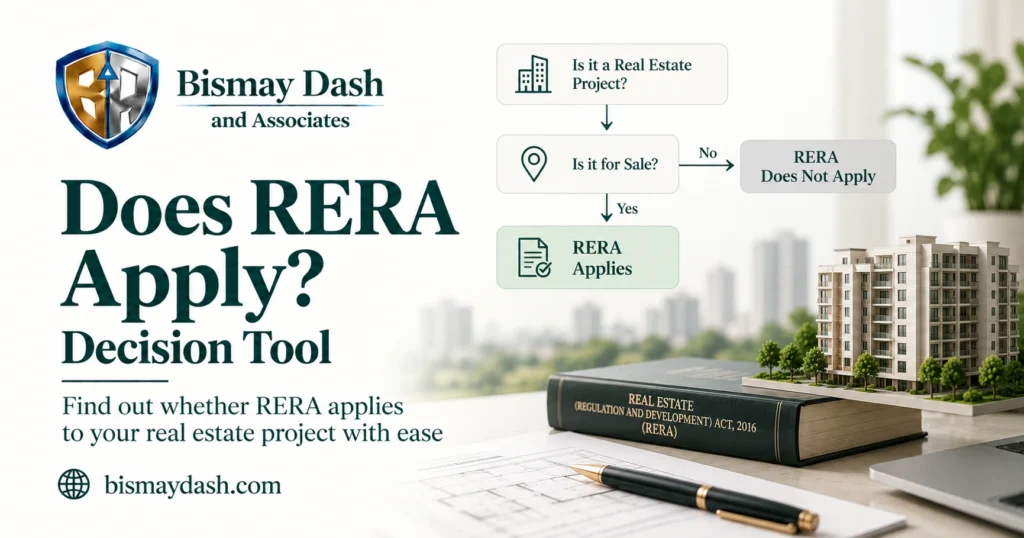
Does RERA Apply? Decision Tool
1. Is this a real estate project, construction of apartments/buildings or development of land into plots for sale?
2. Does the total land area of the project exceed 500 sqm?
3. Does the project have more than 8 apartments (including all phases)?
Per ORERA MISC No. 25/21 (Order No. 2009, dated 15.07.2021), if land exceeds 500 sqm but apartments do not exceed 8 across all phases, RERA registration is not required. The Model Agreement for Sale (2022) applies only to RERA-registered projects.
4. Has the promoter received a Completion / Occupancy Certificate before 1 May 2017 (RERA commencement date)?
5. Is the project located in Odisha?
Whether a project must be registered under the Real Estate (Regulation and Development) Act, 2016 is the first question a promoter, a buyer or a landowner asks when a development is planned. The answer is not a matter of opinion: the Act sets thresholds, the thresholds are tested against the facts of the project, and the result determines whether the promoter may advertise or sell at all. This RERA applicability decision tool walks through the five questions that decide the point and returns a reasoned assessment.
The stakes are high in both directions. A promoter who registers a project that did not need registration takes on compliance obligations unnecessarily; a promoter who fails to register a project that did need it faces penalties under Section 59, including imprisonment. For a buyer, the same question decides whether the protections of the Act - the right to the promised specification, the five-year defect liability, the right to withdraw on delay - are available. Getting the RERA applicability question right is therefore the foundation of everything that follows.
Under Section 3 of the RERA Act, 2016, a real estate project must be registered where the total land area exceeds 500 square metres or the number of apartments to be developed exceeds eight, in either case including all phases. Registration is not required where the promoter has received a completion or occupancy certificate before the commencement date of 1 May 2017.
In Odisha, the regulatory authority is ORERA, and a 2021 order of the Authority clarifies that where land exceeds 500 square metres but the apartments do not exceed eight across all phases, registration is not required. The tool applies these tests in order and states the outcome with its legal basis.
Table of contents
- 1. What the RERA Applicability Decision Tool Does
- 2. The Five Questions, One by One
- 3. The Threshold Test Under Section 3(2)(a)
- 4. Exemptions: Prior Completion and Occupancy Certificates
- 5. Odisha Specifics: ORERA and the 2021 Order
- 6. What Registration Requires of a Promoter
- 7. The Consequences of Not Registering
- 8. A Checklist Before You Decide
- 9. Myths and Facts About RERA Applicability
- 10. Key Takeaways
- 11. Frequently Asked Questions
- 12. Related Guides
- 13. Official Sources
The value of asking the RERA applicability question early is that the answer shapes the entire project. It decides whether an agreement for sale must follow the model form, whether quarterly progress reports must be filed, whether seventy per cent of the amounts realised must be parked in a separate account, and whether a home buyer can approach the Authority for relief. A decision tool that returns a clear yes or no, with the provision behind it, is the fastest way to settle the point before the money is spent.
1. What the RERA Applicability Decision Tool Does
The tool puts the statutory test in the form of five questions and applies them in the order the Act requires. Each question narrows the answer: the first asks whether the activity is a real estate project at all, the next two test the thresholds, the fourth checks the principal exemption, and the fifth confirms that the project is one to which the Odisha authority applies.
1.1 Why five questions and not one
A single threshold would be misleading, because the Act's applicability turns on a combination of facts. A project that develops land into plots for sale is caught even though it builds nothing; a project of exactly eight apartments may escape registration; and a completed project with a prior occupancy certificate is exempt regardless of size. The questions are structured so that no single answer decides the matter on its own.
1.2 What the assessment returns
The tool returns one of three outcomes - registration is mandatory, registration is not required, or the project is not one to which RERA applies - together with a plain-language explanation and the legal basis for the conclusion. Where an exemption applies, the tool states which exemption it is, so that the promoter can see the reasoning rather than only the result.
1.3 What the tool is not
The decision tool is not legal advice and it does not file anything. It does not decide whether a particular activity is a "real estate project" in a borderline case, and it does not compute the registration fee or the cost of compliance. Where the facts are contested, the tool tells you that registration is required or that an exemption may apply, and the matter then belongs with a professional.
2. The Five Questions, One by One
Each question in the tool corresponds to a limb of the statutory test. Reading them in order shows how the RERA applicability decision is actually made.
2.1 Is this a real estate project?
Section 2(zn) defines a real estate project as the development of a building or a group of buildings for the purpose of sale, or the development of land into plots for the purpose of sale. If the activity does not fall within that definition - a purely personal construction, for instance, or a renovation that creates no saleable unit - the Act does not apply at all, and the remaining questions do not arise.
2.2 Does the land exceed 500 square metres?
The first threshold is area. Where the total land area proposed to be developed exceeds five hundred square metres, the project is caught by Section 3(2)(a). The measurement is of the land proposed to be developed, not of the built-up area, and it is taken across the project as a whole.
2.3 Are there more than eight apartments?
The second threshold is the number of apartments. Where the project proposes more than eight apartments, including all phases, the project is caught. The two thresholds are alternatives: a project that exceeds either one is within Section 3(2)(a), which is why the tool treats the land test and the apartment test as separate questions.
2.4 Is there a prior completion or occupancy certificate?
Section 3(2)(b) exempts a project for which the promoter has received a completion certificate or an occupancy certificate before the commencement of the Act on 1 May 2017. This is the principal exemption, and where it applies the project is outside the registration requirement however large it may be.
2.5 Is the project in Odisha?
RERA operates through state authorities, and the Act applies on a state-wise basis. A project in Odisha is regulated by the Odisha Real Estate Regulatory Authority; a project elsewhere is regulated by that state's authority. The fifth question fixes which authority is engaged, and it explains why the tool states the Odisha position expressly.
3. The Threshold Test Under Section 3(2)(a)
The threshold is the heart of the RERA applicability question, and it is worth setting out plainly. The table below states how each combination of facts is treated.
| Land area | Apartments (all phases) | Result under Section 3(2)(a) |
|---|---|---|
| Over 500 sqm | More than eight | Registration is mandatory |
| Over 500 sqm | Eight or fewer | Registration not required (ORERA order of 2021) |
| 500 sqm or less | More than eight | Registration is mandatory (apartment threshold met) |
| 500 sqm or less | Eight or fewer | Registration not required |
The table shows why a promoter cannot test the thresholds one at a time. A project on a small plot with a large number of flats is caught by the apartment count; a project on a large plot with few flats may escape under the Odisha clarification. The RERA applicability decision turns on the combination, and the tool is built to apply the combination rather than a single test.
4. Exemptions: Prior Completion and Occupancy Certificates
The exemption in Section 3(2)(b) is narrow and precise. It applies where the promoter has received a completion certificate or an occupancy certificate in respect of the project before the commencement of the Act. It does not apply where the certificate relates to only part of a project that is otherwise ongoing, and it does not apply where the certificate was obtained after the commencement date.
The reason for the exemption is practical. A project that was already complete and certified before the Act came into force had already delivered to its buyers; there was nothing left for the Act to regulate. For the same reason, a partly completed project that has not received its certificate remains within the Act, and the promoter must register. When you answer this question in the tool, answer it as at the commencement date, not as at today.
A completion certificate for one tower of a multi-tower project does not exempt the project as a whole. The exemption is tested project by project, and the certificate must cover the project for which registration is in question.
5. Odisha Specifics: ORERA and the 2021 Order
In Odisha the authority is the Odisha Real Estate Regulatory Authority, established with effect from 7 October 2017 under Section 30 of the Act. For a promoter or buyer in the State, the RERA applicability question is answered by reference to the Act as applied in Odisha, and the Authority's own orders form part of the picture.
5.1 The threshold clarification of 2021
By its order in ORERA MISC No. 25/21 (Order No. 2009, dated 15 July 2021), the Authority clarified that where the land exceeds five hundred square metres but the apartments do not exceed eight across all phases, registration is not required. The clarification matters because the statutory threshold is disjunctive on its face, and the order settles how it is to be read in Odisha.
5.2 What follows for agreements
The Model Agreement for Sale, 2022, applies only to projects registered under the Act. Where registration is not required, the model form does not bind the promoter, although a fair agreement is still expected. The RERA applicability decision therefore has a direct effect on the paperwork a buyer will be asked to sign.
6. What Registration Requires of a Promoter
Where the tool returns that registration is mandatory, a defined set of obligations follows. They are worth stating because they are the practical content of the RERA applicability answer.
- Register the project with ORERA before advertising, marketing, booking or selling any plot, apartment or building.
- Disclose the promoter's details, the project's land title, the approvals obtained, and the timeline for completion.
- Park seventy per cent of the amounts realised from allottees in a separate account to be used for construction.
- Adhere to the sanctioned plans and the specifications disclosed, and not to make additions or alterations without consent.
- File quarterly progress reports and update the project's registration details on the authority's portal.
- Obtain the completion or occupancy certificate and hand over possession within the agreed time, with the five-year defect liability thereafter.
Each of these obligations is a cost, and that is precisely why the RERA applicability question matters to a promoter: a project that need not be registered should not be burdened with the compliance that registration entails, and a project that must be registered cannot avoid it by declining to apply.
7. The Consequences of Not Registering
Section 59 provides that a promoter who contravenes Section 3, by advertising, selling or offering for sale without registration, is punishable with imprisonment for a term which may extend to three years or with a fine which may extend to ten per cent of the estimated cost of the project, or with both. The penalty is not the only consequence: an agreement entered into in a project that should have been registered is exposed to challenge, and the allottee may seek relief before the Authority.
The asymmetry is the point. The cost of registering a project that needed registration is the cost of compliance; the cost of failing to register a project that needed it is a criminal exposure. Where the RERA applicability decision is genuinely doubtful, the prudent course is to resolve the doubt before advertising, not after a complaint is made.
8. Myths and Facts About RERA Applicability
RERA applies only to large apartment projects, so a small plot is outside it.
Development of land into plots for sale is a real estate project under Section 2(zn), and a plot layout on more than 500 square metres can require registration even though nothing is built.
Eight apartments means registration is never needed.
The two thresholds are alternatives. A project on more than 500 square metres with more than eight apartments is caught, and the Odisha clarification applies only where the apartments do not exceed eight across all phases.
Once a completion certificate exists for one building, the whole project is exempt.
The Section 3(2)(b) exemption is tested project by project, and the certificate must have been received before 1 May 2017 and must cover the project in question.
RERA is a central law applied uniformly, so the state does not matter.
RERA operates through state authorities, and the applicable authority and its orders - such as the ORERA clarification of 2021 - determine how the thresholds apply to a project.
9. Key Takeaways
- A real estate project must be registered where the land exceeds 500 square metres or the apartments exceed eight, including all phases.
- The two thresholds are alternatives; exceeding either one brings the project within Section 3(2)(a).
- A completion or occupancy certificate received before 1 May 2017 exempts a project under Section 3(2)(b).
- In Odisha, ORERA's 2021 order clarifies that land over 500 square metres with not more than eight apartments does not require registration.
- Failure to register is punishable under Section 59 with imprisonment up to three years or a fine up to ten per cent of project cost, or both.
- The RERA applicability decision should be taken before any advertising, booking or sale.
10. Frequently Asked Questions
1. What is the RERA applicability test?
RERA applicability turns on Section 3 of the Real Estate (Regulation and Development) Act, 2016. A real estate project must be registered where the land exceeds 500 square metres or the apartments exceed eight, including all phases, unless a completion or occupancy certificate was received before 1 May 2017.
2. How many questions does the decision tool ask?
Five. They ask whether the activity is a real estate project, whether the land exceeds 500 square metres, whether there are more than eight apartments, whether a prior completion or occupancy certificate exists, and whether the project is in Odisha.
3. Is registration needed if the land is under 500 square metres?
It may still be needed. The thresholds are alternatives, so a project on a small plot with more than eight apartments is caught by the apartment count. The RERA applicability decision depends on both tests together, not on area alone.
4. Does a prior occupancy certificate exempt the project?
Yes, where it was received before 1 May 2017 and covers the project in question. The exemption in Section 3(2)(b) is tested project by project, and a certificate for one tower of a larger project does not exempt the whole.
5. How does Odisha treat a project over 500 square metres with few flats?
By its order in ORERA MISC No. 25/21 (Order No. 2009, dated 15 July 2021), the Authority clarified that where the land exceeds 500 square metres but the apartments do not exceed eight across all phases, registration is not required.
6. What happens if a promoter does not register?
Section 59 makes advertising, selling or offering for sale without registration punishable with imprisonment up to three years or a fine up to ten per cent of the estimated project cost, or both. An allottee may also seek relief before the Authority.
7. Does the model agreement for sale apply if registration is not required?
The Model Agreement for Sale, 2022, applies only to projects registered under the Act. Where registration is not required, the model form does not bind the promoter, although a fair agreement is still expected.
8. Is the assessment from this tool binding?
No. It is an indicative application of the statutory test to the facts you enter. Borderline cases - especially whether an activity is a real estate project - should be settled with a legal professional before a project is advertised or sold.
11. Related Guides
The surrounding questions - how Odisha's land and property framework operates, what registration and stamp duty cost, and how disputes are resolved outside court - are covered in the firm's Knowledge Centre. The companion tools convert several of those steps into figures.
12. Official Sources
- Real Estate (Regulation and Development) Act, 2016, Section 3 - registration of real estate projects, including the thresholds in Section 3(2)(a) and the exemption in Section 3(2)(b).
- RERA Act, 2016, Section 2(zn) - the definition of a real estate project.
- RERA Act, 2016, Section 59 - penalties for advertising or selling without registration.
- ORERA MISC No. 25/21 (Order No. 2009, dated 15 July 2021) - the Odisha clarification on the threshold where land exceeds 500 square metres but apartments do not exceed eight.
- Odisha Real Estate Regulatory Authority (ORERA) - the State regulatory authority's official portal: rera.odisha.gov.in.
The statutory references above point to the sections of this page where each provision is discussed; the ORERA link opens the Authority's official portal. The firm's Knowledge Centre holds the wider reading.
RERA was written to end a market in which buyers paid first and hoped later, and the registration requirement is where that purpose begins. If you are planning a project and are unsure whether it must be registered, or if you are a buyer trying to establish whether the project you are considering falls within the Act, write to the firm and we will work through the RERA applicability question with the papers in front of us.
