
Historical Title Timeline Builder
Land in Odisha has been governed by an unusually long series of legal regimes. A single plot may have passed through presidency revenue law, a princely state's tenancy rules, the estates abolition that followed the merger of the princely states, the land reforms of the 1960s, and the consolidation and settlement operations of the closing decades of the last century - each of which changed who could hold the land and on what terms. This historical title timeline builder sets those regimes out era by era, so that a title search can be framed against the law that actually applied when each transaction took place.
Why does this matter now? Because the validity of an old transfer is judged by the law in force at the time it was made, not by the law today. A sale that was lawful in 1955 is not made void by a statute passed in 1974, and a transfer that was void under a tenancy law cannot be cured by later legislation. To read an old deed, an old settlement record or an old mutation entry correctly, you need to know which regime was in force. The timeline is the frame that makes the older documents legible.
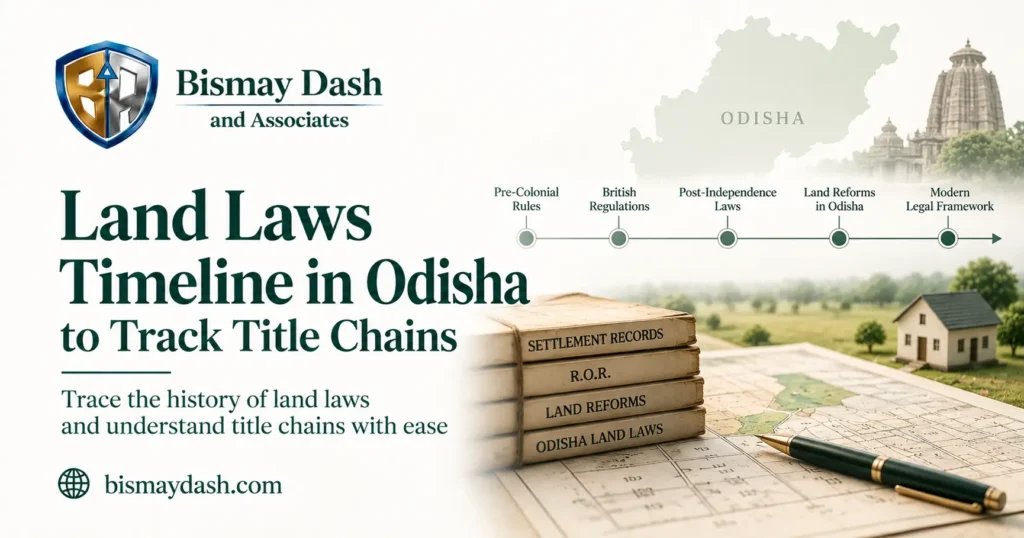
A historical title timeline is a chronology of the legal regimes that governed land in a region over time. In Odisha it runs from the presidency and princely-state laws before 1936, through the provincial and post-independence tenancy reforms, the Odisha Estates Abolition Act, 1951, the land reforms of the 1960s and the consolidation and settlement operations, to the modern statutes on apartments, acquisition and the registration of real estate projects.
The builder presents the regime for the era you select, so that an old document can be read against the law that applied when it was made rather than against the law of today.
Table of contents
- 1. What the Historical Title Timeline Builder Does
- 2. Why Historical Title Matters Today
- 3. The Eras and What Each Means for Title
- 4. Odisha's Legislative Journey
- 5. Princely States and the Merger
- 6. How to Build a Historical Timeline for Your Land
- 7. Where to Find the Old Records
- 8. A Checklist for a Historical Title Search
- 9. Myths and Facts About Historical Title
- 10. Key Takeaways
- 11. Frequently Asked Questions
- 12. Related Guides
- 13. Official Sources
A historical title timeline is not a substitute for the documents; it is the index to them. Once you know which regimes applied in each period, you know which records to look for - the settlement record of a particular survey, the mutation entry made after a particular statute, the order of an estates abolition proceeding - and you know which questions to ask of each. The builder gives you that index, era by era, in a form you can take to the record room.
1. What the Historical Title Timeline Builder Does
The builder divides Odisha's legal history into eras and sets out, for the era you choose, the principal laws and events that bear on land. It is a framework, not a search: it tells you what governed the land in a period, not what happened to a particular plot.
1.1 Seven eras
Seven eras are offered, from the period before Odisha became a separate province in 1936 to the present. Each era carries the statutes, settlement operations and reforms that defined it, so the chronology can be read as a whole or era by era.
1.2 Built for the record room
The output is a numbered timeline, which is the form in which a title search is easiest to conduct. Each entry names a law or an event and states what it did, so that the searcher can match a document in hand to the regime that produced it.
1.3 What it is not
The builder does not tell you the current state of title to any plot, and it does not say whether a particular old transfer was valid. Those questions depend on the documents and on the law as it applied, and they are answered by reading the record against the regime. The tool gives you the regime; the reading remains the lawyer's work.
2. Why Historical Title Matters Today
An old deed is not read in a vacuum. Its meaning depends on the law in force on the date it was executed, and the consequences of an old transaction can survive into the present. Three reasons make the historical enquiry necessary in almost every old-title matter.
2.1 Validity is judged as at the date of the transaction
A transfer that was void under a tenancy or land-reform statute was void when it was made, and no subsequent repeal makes it valid. Conversely, a transfer that was lawful under the law of its day is not invalidated by a later restriction. To judge an old transfer, you must know the law of its day, which is exactly what the timeline supplies.
2.2 The settlement record follows the statute
Settlement operations were conducted under particular statutes and produced records in a particular form. A settlement record from one survey cannot be read as though it were produced under another. Knowing which survey and which statute produced a record is the first step in reading it.
2.3 Restrictions can persist
Restrictions on the transfer of land held by members of Scheduled Tribes, and the position of government and forest land, are examples of limits that arose under earlier law and continue to shape what can be done with the land. The timeline shows where those limits came from, which is often the key to understanding why a modern transaction is caught by them.
3. The Eras and What Each Means for Title
Each era in the builder corresponds to a distinct legal environment. The table below states what characterises each one for the purposes of a title search.
| Era | What it means for title |
|---|---|
| Pre-1936 | Presidency and princely-state laws applied, depending on the district; the tenancy and revenue law of the relevant presidency or state governs. |
| 1936–1950 | Odisha as a separate province; adapted tenancy legislation and the continuation of princely-state law in areas not yet merged. |
| 1950–1960 | Post-independence reforms; the estates abolition legislation and the survey and settlement statute reshape holdings. |
| 1960–1980 | The land reforms era; ceiling, tenancy and transfer restrictions, and the consolidation statute. |
| 1980–2000 | Consolidation and settlement operations, revisional settlement, and the development-authority and apartment statutes. |
| 2000–2020 | Modern reforms; the forest rights statute, the acquisition framework, and the registration of real estate projects. |
| 2020–present | The current era; the apartment ownership statute, special survey procedures and digitisation of revenue records. |
Read together, the eras explain why old records look the way they do. A settlement record from the 1950s reflects the abolition of estates; a mutation entry from the 1970s reflects the consolidation operations; a modern record reflects the digitised land records system. The historical title timeline is the thread that connects them.
4. Odisha's Legislative Journey
The statutes that shaped land in Odisha did not arrive in a single reform but in waves, and each wave left its mark on the records.
4.1 The tenancy and settlement statutes
The Odisha Survey and Settlement Act, 1958, provided the framework under which holdings were surveyed and settled, and it is the source of much of the record structure still in use. The tenancy legislation of the provincial and early post-independence period defined the rights of tenants and the conditions on which land could be held.
4.2 Estates abolition
The Odisha Estates Abolition Act, 1951, abolished the intermediary interests in the estates to which it applied, converting holders into direct tenants of the State. For land that was once part of an estate, the abolition is the pivot on which the modern title turns, and the settlement proceedings that followed are the records to look for.
4.3 Land reforms and consolidation
The Odisha Land Reforms Act, 1960, and its rules dealt with ceilings, tenancy and restrictions on transfer, while the Odisha Consolidation of Holdings Act, 1972, and the settlement operations of the following decades rearranged holdings and produced fresh records. These are the statutes that explain most of the twentieth-century entries in a title chain.
4.4 Modern statutes
The more recent layer includes the forest rights legislation of 2006, the land acquisition framework of 2013, the real estate regulation of 2016, and the apartment ownership statute of 2023. Each bears on what can be done with land now, and each has its own records and processes.
5. Princely States and the Merger
Odisha was assembled, in part, from princely states whose internal law differed from that of the British-administered districts. For land that lay within a former princely state, the starting point of the timeline is not the presidency law but the law of that state, and the point of transition is the merger by which the state became part of Odisha.
This has two practical consequences. First, the early documents for such land may follow forms and terminology that differ from the district records, so they should be read against the state's own practice. Second, the merger is the event that brought the land within the Odisha framework, and the records generated around the merger are often the bridge between the old title and the modern record. A historical title timeline that includes the pre-1936 and 1936–1950 eras is therefore essential for land in the former princely areas.
6. How to Build a Historical Timeline for Your Land
Building a timeline for a particular plot is a matter of placing the documents you have against the eras the builder sets out.
- Identify the district and, if applicable, the former princely state in which the land lies.
- Establish the earliest document you hold, and select the era in which it was created.
- Read that document against the regime for its era, noting the statute under which it was made.
- Move forward era by era, matching each later document to the reform that produced it.
- Note every point at which a statute changed what could be held or transferred, and check the chain against it.
- Where a settlement or consolidation operation intervened, locate its record and reconcile it with the deed.
- Check the modern record for restrictions - tribal, government or forest - that originated in an earlier regime.
- Assemble the documents into a single chronology, so that gaps and anomalies become visible.
The chronology is the deliverable. Once the documents are arranged against the eras, the questions that matter - where title came from, whether each transfer was competent, whether a restriction applies - can be asked in an orderly way instead of in the dark.
7. Where to Find the Old Records
Old records are held in different places according to their age and kind. Settlement and survey records, mutation registers and estate records are ordinarily held in the revenue offices, while registered deeds are held in the registration offices. The State's land records portal now provides current records of rights and maps, which is a useful starting point, though the older paper records still have to be traced through the offices. The timeline tells you which office and which series to ask for, because the record you need is the record produced under the statute of the era in question.
8. Myths and Facts About Historical Title
Old documents are irrelevant because the current record settles everything.
The current record shows the present position, but title rests on the chain of documents. An old transfer that was void, or a restriction that persists, can affect the land today.
If a transfer was lawful when it was made, later law can undo it.
Validity is judged as at the date of the transaction. A lawful transfer is not made void by later legislation, and a void one is not cured by it, which is why the era matters.
All of Odisha was governed by the same law before 1936.
Different districts were under different presidencies, and the princely states had their own law. For former princely-state land, the state's law is the starting point.
A historical timeline can be built from the current record alone.
The current record is one point in the chain. A historical title timeline requires the older documents, placed against the statutes that produced them.
9. Key Takeaways
- A historical title timeline arranges the legal regimes that governed land over time, so old documents can be read against the law of their day.
- Validity of an old transfer is judged as at the date it was made, which is why the era matters.
- Odisha's regimes run from presidency and princely-state law, through tenancy and estates abolition, to land reforms, consolidation and the modern statutes.
- For land in a former princely state, the state's own law is the starting point, and the merger is the bridge to the Odisha framework.
- Settlement and consolidation records are read against the statute that produced them, not as interchangeable records.
- Restrictions such as those on tribal, government and forest land can originate in an earlier regime and persist.
10. Frequently Asked Questions
1. What is a historical title timeline?
It is a chronology of the legal regimes that governed land in a region over time. In Odisha it runs from the presidency and princely-state laws before 1936, through the tenancy reforms and estates abolition, to the land reforms, consolidation operations and modern statutes.
2. Why does the era matter for an old document?
The validity of a transfer is judged by the law in force when it was made. A historical title timeline tells you which regime applied in each period, so an old deed, settlement record or mutation entry can be read against the law of its day.
3. How many eras does the builder cover?
Seven, from the period before Odisha became a separate province in 1936 to the present. Each era carries the principal statutes, settlement operations and reforms that defined it.
4. What if the land was in a former princely state?
For such land the starting point is the law of that state, not the presidency law, and the merger is the event that brought the land within the Odisha framework. The records generated around the merger are often the bridge between the old title and the modern record.
5. Does an old transfer become invalid if a later law restricts it?
No. A transfer that was lawful when it was made is not invalidated by later legislation, and one that was void when made is not cured by it. The historical title timeline shows the regime that applied, so the position can be judged correctly.
6. Which records should I look for?
Settlement and survey records, mutation registers and estate records are held in the revenue offices, and registered deeds in the registration offices. The era tells you which series to ask for, because the record you need is the one produced under the statute of that period.
7. Is the current record of rights enough?
No. The current record shows the present position, but title rests on the chain of documents. Restrictions and defects that arose in an earlier era can still affect the land, which is why the historical enquiry is necessary.
8. Can the builder tell me the title to my land?
No. It gives you the regimes to read the documents against. Whether a particular old transfer was competent, and what the land's title is today, depends on the documents and should be assessed by a legal professional.
11. Related Guides
The surrounding questions - how Odisha's land and property framework operates, how a title chain is proved, and what documents a transaction requires - are covered in the firm's Knowledge Centre and by the companion tools.
12. Official Sources
- Odisha Survey and Settlement Act, 1958 - the framework under which holdings were surveyed and settled.
- Odisha Estates Abolition Act, 1951 - abolition of intermediary interests in the estates to which it applied.
- Odisha Land Reforms Act, 1960, and the Odisha Consolidation of Holdings Act, 1972 - ceilings, tenancy, transfer restrictions and consolidation operations.
- Forest Rights Act, 2006; RFCTLARR Act, 2013; RERA, 2016; Odisha Apartment (Ownership and Management) Act, 2023 - the modern layer.
- India Code, Ministry of Law and Justice - the official consolidated text of central legislation, and a gateway to State Acts: indiacode.nic.in.
The statutory references above point to the sections of this page where each provision is discussed; the India Code link opens the official text of legislation. The firm's Knowledge Centre holds the wider reading.
An old title is a conversation between documents and statutes, and the statutes are half of it. If you are dealing with land whose records reach back into the estate, princely-state or reform periods, and you need the history arranged before it can be assessed, write to the firm and we will build the chronology with you from the records.
