
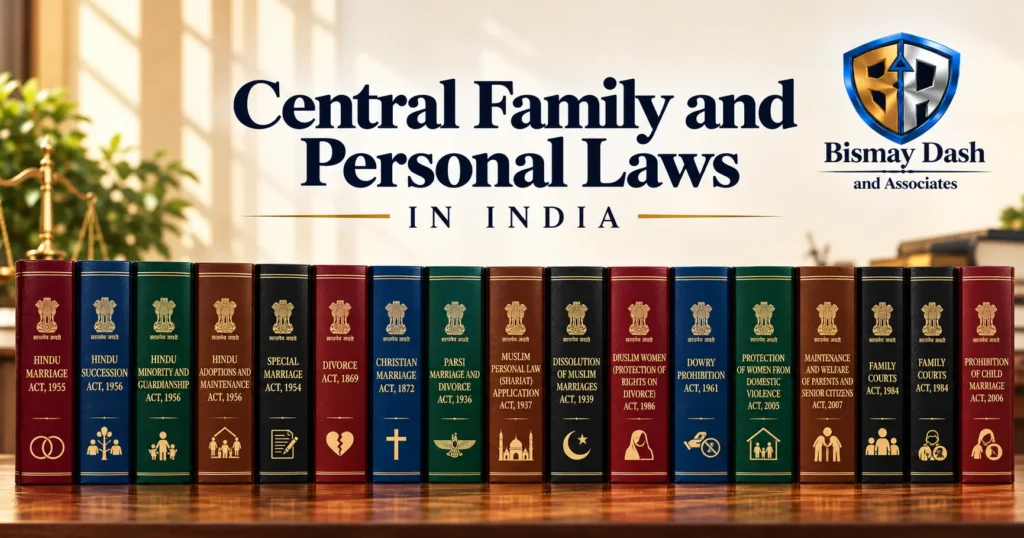
The central family and personal laws of India govern marriage, divorce, succession, guardianship and maintenance for every community — Hindu, Muslim, Christian, Parsi and civil marriages under the Special Marriage Act.
Personal laws run along community lines: the four Hindu law statutes of 1955–56, the Shariat Application Act for Muslims, the Christian and Parsi statutes of the nineteenth and early twentieth centuries, and the Special Marriage Act as the secular route. Over these sit the protection statutes of recent decades — against dowry, domestic violence and child marriage — and the welfare laws for parents and senior citizens.
This page lists the principal central family and personal statutes, what each covers, and links to authoritative texts. All acts here are central laws enacted by Parliament — state-enacted laws are covered separately.
Contents
Marriage and Personal Laws
| Act | What it covers |
|---|---|
| Hindu Marriage Act, 1955 (25 of 1955) | Conditions for a valid Hindu marriage, ceremonies, restitution of conjugal rights, judicial separation and divorce. |
| Hindu Succession Act, 1956 (30 of 1956) | Intestate and testamentary succession among Hindus; since 2005, daughters are coparceners with equal birthright in coparcenary property. |
| Hindu Minority and Guardianship Act, 1956 (32 of 1956) | Who is the natural guardian of a Hindu minor, the guardian’s powers over the minor’s person and property, and the wardship court’s overriding jurisdiction. |
| Hindu Adoptions and Maintenance Act, 1956 (78 of 1956) | Validity of adoptions, capacities of giver and taker, and the obligation to maintain a wife, children and aged parents. |
| Special Marriage Act, 1954 (43 of 1954) | Civil marriage available to parties of any faith, registration of marriages, and the divorce and alimony rules that follow. |
| Divorce Act, 1869 (4 of 1869) | Dissolution of marriage, judicial separation and ancillary relief for Christians. |
| Christian Marriage Act, 1872 (15 of 1872) | Solemnisation and registration of Christian marriages and the licensing of ministers. |
| Parsi Marriage and Divorce Act, 1936 (3 of 1936) | Parsi marriages, the grounds of divorce and the special Parsi matrimonial courts. |
| Muslim Personal Law (Shariat) Application Act, 1937 (26 of 1937) | Directs that in family and succession matters Muslims are governed by their personal law (Shariat). |
| Dissolution of Muslim Marriages Act, 1939 (8 of 1939) | Grounds on which a married Muslim woman may obtain dissolution of her marriage through the court. |
| Muslim Women (Protection of Rights on Divorce) Act, 1986 (25 of 1986) | Rights of a divorced Muslim woman to mehr, maintenance and return of properties. |
Protection and Welfare Statutes
| Act | What it covers |
|---|---|
| Dowry Prohibition Act, 1961 (28 of 1961) | Prohibits the giving, taking and demanding of dowry, penalises dowry agreements and provides for dowry to pass to the bride. |
| Protection of Women from Domestic Violence Act, 2005 (43 of 2005) | Civil protection orders, right of residence in the shared household, maintenance and compensation for victims of domestic abuse. |
| Maintenance and Welfare of Parents and Senior Citizens Act, 2007 (56 of 2007) | Obligation of children and heirs to maintain parents and senior citizens, with a speedy maintenance tribunal. |
| Family Courts Act, 1984 (66 of 1984) | Specialised family courts for marriage, custody and maintenance disputes, with conciliation as the first step. |
| Prohibition of Child Marriage Act, 2006 (6 of 2007) | Prohibits child marriages, makes them voidable at the minor’s option and punishes adults who promote them. |
For succession to property in estate matters, see our central civil and commercial laws library; for the constitutional framework of family life, the constitutional and administrative laws library.
Frequently Asked Questions
Which law applies to a marriage between two Hindus?
The Hindu Marriage Act, 1955 governs its validity and dissolution; the Hindu Succession Act, 1956 and the Hindu Adoption and Maintenance Act, 1956 govern the property side.
Can a couple of different religions marry without conversion?
Yes — under the Special Marriage Act, 1954, a civil marriage is available to any two persons regardless of faith.
What can a victim of domestic abuse ask the court for?
Under the Protection of Women from Domestic Violence Act, 2005: protection orders, residence in the shared household, maintenance, custody of children and compensation — all civil remedies available alongside criminal proceedings.
This page is a general library guide published for the Knowledge Centre and is not legal advice. For advice on a specific matter, please contact the firm.