
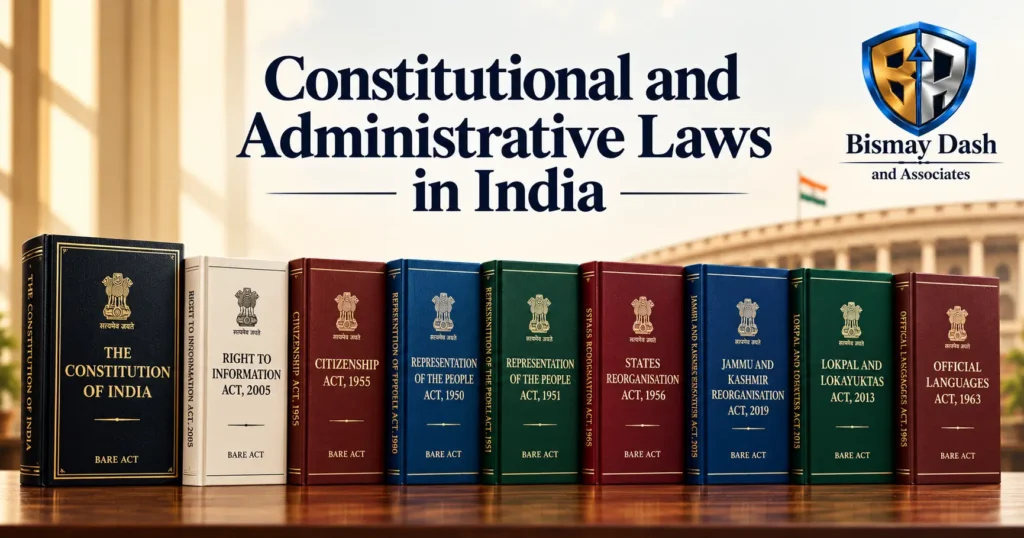
The constitutional laws of India begin with one document — the Constitution of India, 1950 — and extend through the statutes that operationalise it: the Right to Information Act, the Citizenship Act, the election laws and the Acts that reorganised the Union itself.
Adopted on 26 November 1949 and brought into force on 26 January 1950, the Constitution is the supreme law of India: 25 Parts, over 100 amendments and Twelve Schedules that distribute power between the Union and the States and guarantee fundamental rights to every person. Around it stands a body of administrative legislation — from elections to official languages to anti-corruption ombudsmen.
This page lists the principal constitutional and administrative laws with a short description of each and links to authoritative texts. The Constitution itself is published in full on this site.
Contents
The Constitution of India
| Act | What it covers |
|---|---|
| The Constitution of India, 1950 — complete bare text on this site | The supreme law of India: the Preamble, all 25 Parts (including the Fundamental Rights in Part III and Directive Principles in Part IV), the Twelve Schedules and over 100 amendments. Reproduced word-for-word, as amended up to the 106th Amendment, with a clickable table of contents. |
Administrative and Election Statutes
| Act | What it covers |
|---|---|
| Right to Information Act, 2005 (22 of 2005) | Citizens’ right to obtain information from public authorities: information commissions, timelines, exemptions and the public-interest override. |
| Citizenship Act, 1955 (57 of 1955) | Acquisition and loss of Indian citizenship by birth, descent, registration and naturalisation; the Citizenship (Amendment) Act, 2019 was notified with its rules in March 2024. |
| Representation of the People Act, 1950 (43 of 1950) and Representation of the People Act, 1951 (43 of 1951) | Election law: the 1950 Act deals with electoral rolls and seat allocation; the 1951 Act with the conduct of elections, disputes, corrupt practices and disqualifications. |
| States Reorganisation Act, 1956 (37 of 1956) | Redrew India’s state map on linguistic lines, abolishing Part B states — the Act whose repeal also omitted Part VII of the Constitution. |
| Jammu and Kashmir Reorganisation Act, 2019 (34 of 2019) | Reorganised the State of Jammu and Kashmir into the two Union Territories of Jammu and Kashmir, and Ladakh, with effect from 31 October 2019. |
| Lokpal and Lokayuktas Act, 2013 (1 of 2014) | The anti-corruption ombudsman for the Union (Lokpal) and the States (Lokayuktas): jurisdiction, inquiry and prosecution of public servants. |
| Official Languages Act, 1963 (19 of 1963) | Continues English for official purposes of the Union alongside Hindi and provides for languages of the States and the Eighth Schedule machinery. |
Related libraries: the central criminal laws and the central civil and commercial laws libraries on this site.
Frequently Asked Questions
How many parts does the Constitution of India have?
Twenty-five: the original Parts I to XXII, minus Part VII (omitted in 1956), plus the four lettered Parts added by amendment — IVA, IXA, IXB and XIVA. The full text of all 25 Parts and the Twelve Schedules is on our Constitution page.
What is the supreme law of India?
The Constitution of India. Article 13 renders void any law inconsistent with it, and Article 368 governs its amendment, subject to the Supreme Court’s basic-structure doctrine.
Where can I read the full Constitution of India?
The complete bare text, Preamble to the Twelfth Schedule, is published on this site with a clickable table of contents; the official consolidated editions are on the Legislative Department portal.
This page is a general library guide published for the Knowledge Centre and is not legal advice. For advice on a specific matter, please contact the firm.