A comprehensive exploration of modern dispute resolution mechanisms and the indispensable role of legal advocates in achieving swift, cost-effective and amicable justice — from the binding authority of arbitration to India’s indigenous Lok Adalat.
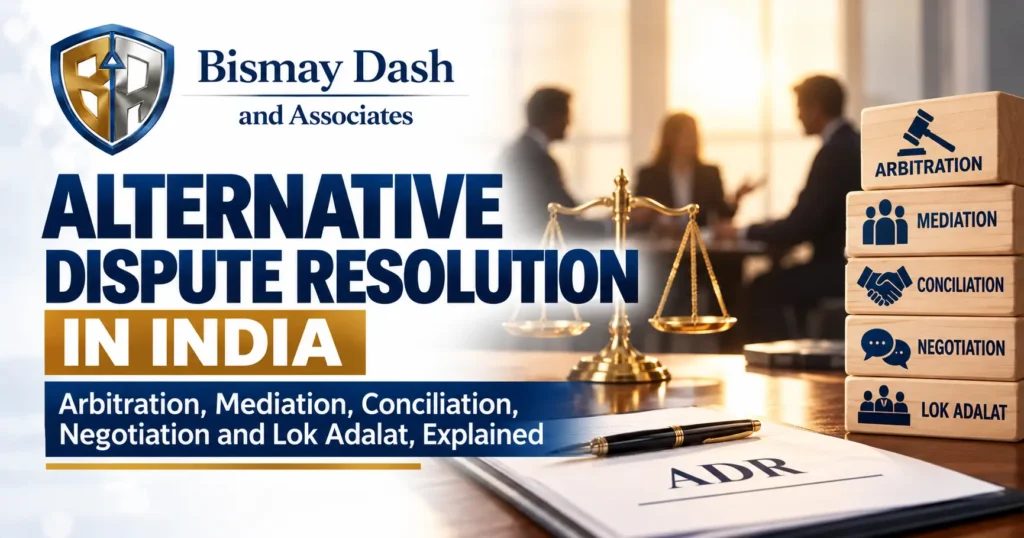
- Alternative dispute resolution in India spans five distinct mechanisms — arbitration, mediation, conciliation, negotiation and Lok Adalat — each with its own philosophy, procedure and appropriate use.
- Arbitration is adjudicative: an arbitral award has the same status and enforceability as a court decree, with challenges confined to the narrow grounds in Section 34 of the Arbitration and Conciliation Act, 1996.
- Mediation and conciliation are consensual: the mediator facilitates while the parties decide; a conciliator additionally evaluates merits and proposes settlement terms.
- Lok Adalat, under the Legal Services Authorities Act, 1987, resolves disputes at zero court fee, and its settlements are deemed civil court decrees that cannot be appealed.
- Section 89 of the Code of Civil Procedure, 1908 and Section 12A of the Commercial Courts Act, 2015 build ADR into the litigation process itself.
- The Mediation Act, 2023 institutionalises mediation through the Mediation Council of India, and explicitly recognises online mediation.
- Advocates remain central to ADR — as strategic advisors, drafters, negotiators and enforcers — across a six-phase engagement from case assessment to challenging outcomes.
Alternative dispute resolution (ADR) in India is the body of mechanisms — arbitration, mediation, conciliation, negotiation and Lok Adalat — by which disputes are resolved outside the traditional courtroom. Arbitration ends in a binding award enforceable as a court decree under the Arbitration and Conciliation Act, 1996; mediation and conciliation produce consensual settlements (now governed by the Mediation Act, 2023); and Lok Adalat delivers decree-status settlements at no court fee under the Legal Services Authorities Act, 1987. Together with Section 89 of the Civil Procedure Code and Section 12A of the Commercial Courts Act, 2015, these mechanisms make ADR a mainstream — often mandatory — first step in Indian dispute resolution.
Table of Contents
1.What Is Alternative Dispute Resolution in India?
Courts remain the final arbiter of legal rights in India, but the journey through them is famously slow, expensive and adversarial. Alternative dispute resolution in India is the collective name for the structured mechanisms that resolve disputes outside that traditional courtroom route — some of which end in decisions as binding as any decree, and some of which leave the outcome entirely in the parties’ own hands.
Alternative dispute resolution in India is not a monolithic concept but rather a sophisticated spectrum of distinct mechanisms, each with its own philosophical underpinnings, procedural frameworks, and appropriate applications. Understanding these mechanisms in their full complexity is essential for parties seeking to resolve disputes effectively and for advocates guiding their clients through these processes.
At one end of the spectrum sits arbitration, a private judicial process that culminates in a binding award. In the middle sit mediation and conciliation, assisted-negotiation processes that seek consensual settlement. At the most informal end sits negotiation itself — direct dealing between the parties. And alongside them all operates Lok Adalat, India’s indigenous, cost-free forum for mass settlement. This guide examines each mechanism in turn, the statutes that govern them, the role advocates play across the entire dispute lifecycle, and the trends shaping the future of Indian ADR.
2.The Five Mechanisms at a Glance
Before examining each mechanism in depth, it helps to see the whole spectrum side by side. The essential differences are who controls the outcome, how binding the result is, and what role the third party plays.
| Mechanism | Third party | Who decides the outcome | Nature of the result |
|---|---|---|---|
| Arbitration | Arbitrator or arbitral tribunal | The tribunal | Binding arbitral award; same status and enforceability as a court decree; challenge limited to narrow statutory grounds |
| Mediation | Mediator — a neutral facilitator with no decision-making power | The parties themselves | Settlement reached only by consent; mediated settlement agreements are enforceable under the Mediation Act, 2023 |
| Conciliation | Conciliator — takes an active, evaluative role | The parties themselves | Signed settlement agreement has the same status and effect as an arbitral award |
| Negotiation | None — parties or their representatives deal directly | The parties themselves | Whatever legally binding agreement the parties choose to make |
| Lok Adalat | Bench of serving or retired judicial officers, advocates and social workers acting as conciliators | The parties, by compromise | Settlement deemed a decree of a civil court; final and binding, with no appeal |
With that map in place, each mechanism can now be examined in the depth that practitioners and disputants actually need.
3.Arbitration: The Adjudicative Alternative with Binding Authority
Arbitration represents the most formalized and adjudicative form of alternative dispute resolution, functioning as a private judicial process where parties voluntarily submit their disputes to one or more arbitrators who render a binding decision known as an arbitral award. Unlike other ADR mechanisms that seek consensus and compromise, arbitration culminates in a definitive determination of rights and obligations, making it particularly suitable for disputes requiring authoritative resolution.
The foundational premise of arbitration rests on party autonomy and consensual submission to the arbitral process. This consent typically manifests through arbitration clauses embedded in commercial contracts, which specify that any disputes arising from the contractual relationship will be resolved through arbitration rather than litigation. The binding nature of this agreement is recognized and enforced by Indian law, specifically the Arbitration and Conciliation Act of 1996, which provides the comprehensive legislative framework governing both domestic and international arbitration in India.
The Architecture of Arbitration Proceedings
Arbitration proceedings in India typically commence when one party serves a notice of arbitration upon the other, invoking the arbitration clause in their agreement. This notice triggers a series of procedural steps including the constitution of the arbitral tribunal, determination of the seat and venue of arbitration, establishment of procedural rules, and setting of timelines for various stages of the proceedings. The parties enjoy considerable flexibility in designing these procedures, though the Arbitration Act provides default provisions that apply when parties have not agreed otherwise.
The constitution of the arbitral tribunal is a critical phase where parties select individuals with appropriate expertise to adjudicate their dispute. For domestic arbitrations, parties commonly agree on a sole arbitrator or a panel of three arbitrators. In international commercial arbitrations, institutional rules often govern arbitrator appointments. The selection process allows parties to choose arbitrators with specialized knowledge in the subject matter of the dispute, whether it be construction, intellectual property, maritime law, or any other technical field, thereby ensuring that the decision-makers possess genuine expertise relevant to the issues at hand.
The evidentiary and procedural phases of arbitration bear similarity to courtroom litigation but with significantly greater flexibility and efficiency. Parties submit written statements of claim and defense, exchange documents through discovery processes, present witness testimony, submit expert evidence, and make legal arguments. However, unlike court proceedings governed by strict rules of evidence and procedure, arbitration allows parties to agree on streamlined processes that eliminate unnecessary formalities while maintaining fairness and due process. The arbitral tribunal has the authority to determine admissibility of evidence, relevance of issues, and procedural matters, subject to principles of natural justice and the mandatory provisions of the Arbitration Act.
Notice of arbitration
One party invokes the arbitration clause by serving a notice on the other, setting the process in motion.
Constitution of the tribunal
Parties appoint a sole arbitrator or a three-member panel — often choosing specialists in the subject matter — and fix the seat, venue, rules and timelines.
Pleadings and discovery
Statements of claim and defense are filed and documents are exchanged through streamlined discovery processes.
Evidence and hearings
Witnesses testify, expert evidence is submitted and legal arguments are made — with formalities the parties have agreed to dispense with.
The arbitral award
The tribunal delivers a reasoned, signed award with the same status and enforceability as a court decree.
Distinct Categories and Characteristics of Arbitration
Domestic vs. International Arbitration
Domestic arbitration involves parties from within India and is governed by Part I of the Arbitration Act, while international commercial arbitration involves a foreign party or is seated outside India, governed by specific provisions that align with international standards. International arbitrations often involve institutional rules such as those of the International Chamber of Commerce (ICC), London Court of International Arbitration (LCIA), or Singapore International Arbitration Centre (SIAC), bringing international best practices to the dispute resolution process.
Governing split: Part I (domestic) vs. international provisions
Institutional vs. Ad-hoc Arbitration
Institutional arbitration is administered by established arbitration institutions like the Mumbai Centre for International Arbitration (MCIA) or Delhi International Arbitration Centre (DIAC), which provide administrative support, standardized rules, and quality control. Ad-hoc arbitration, conversely, is organized by the parties themselves without institutional involvement, offering maximum flexibility but requiring greater party involvement in procedural administration.
Administration by an institution vs. by the parties themselves
Fast-Track Arbitration
Recognizing the need for expedited resolution in certain disputes, the 2015 amendments introduced fast-track arbitration for cases where parties agree or the claim value is below specified thresholds. Fast-track proceedings mandate completion within six months, with streamlined procedures that eliminate oral hearings unless necessary, significantly reducing time and costs.
Six-month completion mandate
Emergency Arbitration
Modern institutional rules provide for emergency arbitration, allowing parties to obtain urgent interim relief before the constitution of the full arbitral tribunal. This mechanism addresses situations requiring immediate protective measures, such as preservation of assets or prevention of irreparable harm, ensuring that parties are not disadvantaged by the time required to constitute the tribunal.
Urgent interim relief before the tribunal is constituted
The Arbitral Award: Finality and Enforcement
The culmination of arbitration proceedings is the arbitral award, a written decision that resolves the disputes submitted to arbitration. The award must be reasoned, signed by the arbitrators, and delivered to parties within the timeframe specified by law or agreement. Under the Arbitration Act, arbitral awards have the same status and enforceability as court decrees, meaning they can be executed through normal court enforcement mechanisms without requiring a fresh trial on merits.
The finality of arbitral awards is protected by limited grounds for challenge. Section 34 of the Arbitration Act permits setting aside of awards only on narrow grounds including incapacity of parties, invalidity of arbitration agreement, lack of proper notice, adjudication beyond the scope of submission, improper tribunal composition, non-arbitrability of subject matter, or conflict with public policy. This limited review ensures that arbitration delivers final resolution without protracted post-award litigation that would defeat its efficiency objectives.
Practical Application: Construction Dispute Arbitration
Consider a scenario where a real estate developer and a construction contractor are embroiled in a dispute involving alleged defects in construction work, claims for additional payments, and counter-claims for delays. The construction contract contains an arbitration clause specifying that disputes will be resolved by a sole arbitrator with engineering expertise, applying the rules of the MCIA. The contractor serves a notice of arbitration, the parties jointly appoint a retired civil engineer as arbitrator, and proceedings commence. Over six months, both parties submit detailed technical reports, engineering experts testify, financial records are examined, and site inspections are conducted. The arbitrator ultimately renders an award quantifying the defects, apportioning responsibility, and determining final payments. This award is binding, immediately enforceable, and subject to challenge only on the narrow grounds specified in the Arbitration Act, providing conclusive resolution to a complex technical dispute far more efficiently than litigation in civil courts would permit.
4.Mediation: The Collaborative Path to Consensual Resolution
Mediation represents perhaps the purest form of alternative dispute resolution, embodying a fundamentally different philosophy from adjudicative processes. Where arbitration and litigation seek to determine who is right through application of legal rules and evidence, mediation asks what resolution the parties themselves can craft that addresses their underlying interests, preserves relationships, and creates value for all involved. This paradigm shift from adversarial determination to collaborative problem-solving makes mediation particularly effective for disputes where ongoing relationships matter, creative solutions are possible, and parties retain the desire to control their own outcomes.
The essence of mediation lies in the role of the mediator as a neutral facilitator who assists parties in communicating, understanding each other’s perspectives, identifying common ground, and developing mutually acceptable solutions. Unlike an arbitrator or judge who imposes a decision, the mediator has no decision-making authority. The mediator’s tools are process management, facilitation techniques, reality testing, and creative problem-solving, not legal judgment or evidentiary rulings. This fundamental distinction means that mediation empowers parties to craft solutions that a court or arbitrator, constrained by legal remedies and jurisdictional limits, could never order.
The Mediation Process: Structure within Flexibility
While mediation is inherently flexible and can be adapted to the specific needs of each dispute, successful mediations typically follow a structured progression through several distinct phases. The process commonly begins with an opening session where the mediator explains the mediation process, establishes ground rules, confirms confidentiality, and sets the stage for productive dialogue. Each party then presents their perspective on the dispute, not as legal arguments to be judged, but as narratives to be understood. The mediator actively listens, asks clarifying questions, and helps parties identify the underlying interests and needs beyond their stated positions.
Following these opening statements, the mediator may employ various techniques including joint problem-solving sessions where parties explore options together, private caucuses where the mediator meets separately with each party to explore sensitive issues, reality testing where the mediator helps parties assess the strengths and weaknesses of their positions, and option generation where creative alternatives are brainstormed. The mediator serves as a communication bridge, transmitting proposals, identifying areas of potential agreement, and helping parties move incrementally toward resolution.
The flexibility of mediation extends to when and how it can be employed. Pre-litigation mediation allows parties to resolve disputes before formal legal proceedings commence, saving litigation costs entirely. Court-annexed mediation, mandated or suggested by courts for pending cases, provides an opportunity for settlement even after litigation has begun. Post-award or post-judgment mediation can help parties resolve implementation issues or modify awards to reflect changed circumstances. This versatility makes mediation applicable at any stage of a conflict’s lifecycle.
Distinctive Features and Advantages of Mediation
- Preservation of relationships: Unlike adversarial processes that often irreparably damage relationships, mediation’s collaborative nature can actually strengthen relationships by improving communication and mutual understanding. This is particularly valuable in family disputes, employment conflicts, partnership disagreements, and commercial relationships where parties must continue interacting after the dispute is resolved.
- Confidentiality and privacy: Mediation proceedings are entirely confidential, with communications made during mediation protected from disclosure in subsequent legal proceedings. This confidentiality encourages candid discussion, exploration of settlement possibilities without prejudice to legal positions, and protection of sensitive business or personal information that would become public in court proceedings.
- Creative and customized solutions: Courts and arbitrators are limited to remedies within their legal and jurisdictional authority. Mediation, by contrast, allows parties to craft any mutually acceptable solution, including structured payments, performance obligations, future business arrangements, public or private apologies, or any other terms the parties deem valuable. This creativity often produces outcomes superior to what litigation could achieve.
- Time and cost efficiency: Mediation typically concludes within days or weeks, not the months or years common in litigation and arbitration. The informal process eliminates discovery costs, reduces attorney fees, and avoids court filing fees and procedural expenses. Many successful mediations conclude in a single day-long session, providing immediate closure.
- Party control and empowerment: Mediation places decision-making authority entirely with the parties, not with a third-party adjudicator. No settlement is imposed; parties agree only to terms they find acceptable. This control ensures satisfaction with outcomes and high rates of voluntary compliance with mediated agreements.
- High success rates: Statistical studies consistently demonstrate that mediation achieves settlement rates exceeding 70-85% across various dispute types. This success reflects mediation’s effectiveness in helping parties find common ground and resolve their differences collaboratively.
Court-Annexed Mediation and Institutional Frameworks
Recognizing mediation’s potential to reduce court congestion while delivering superior outcomes, Indian courts have established mediation and conciliation centers across the country. These centers, operating under the aegis of High Courts and District Courts, provide trained mediators, mediation facilities, and standardized procedures for referring court cases to mediation. The Commercial Courts Act mandates pre-institution mediation for specified commercial disputes, requiring parties to attempt mediation before filing suits, demonstrating the legislative commitment to mediation as a first resort rather than last resort.
The recent passage of the Mediation Act by the Indian Parliament provides comprehensive legislative recognition and support for mediation. This Act establishes the Mediation Council of India to promote and regulate mediation, provides for registration and accreditation of mediators, specifies enforceability of mediated settlement agreements, extends legal protection to mediators, and creates a robust framework for both pre-litigation and court-referred mediation. This legislative development signals India’s commitment to institutionalizing mediation as a mainstream dispute resolution mechanism.
5.Conciliation: Expert-Assisted Settlement Facilitation
Conciliation occupies a middle ground between mediation’s pure facilitation and arbitration’s adjudicative authority. Like mediation, conciliation seeks consensual settlement through assisted negotiation. However, conciliators play a more active and interventionist role than mediators, offering opinions on the merits of positions, suggesting settlement terms, and providing expert views on appropriate resolutions. This enhanced role makes conciliation particularly effective when parties need not just facilitation but also expert guidance on reasonable settlement parameters.
Part III of the Arbitration and Conciliation Act, 1996, provides the statutory framework for conciliation in India, modeling it on the UNCITRAL Conciliation Rules. The Act provides that conciliation can be invoked by agreement between parties or even unilaterally by one party inviting the other to conciliation. Once parties agree to conciliate, they jointly appoint one or more conciliators who assist them in reaching settlement.
Distinctive Characteristics of Conciliation
- Active role of the conciliator: Unlike mediators who refrain from offering opinions on merits, conciliators actively assess the dispute, evaluate the strengths and weaknesses of each party’s position, and propose specific settlement terms. This expert input helps parties develop realistic assessments of their cases and identify reasonable settlement zones.
- Flexibility in initiation: Conciliation does not require pre-existing agreement. One party can invite another to conciliation even without a contractual obligation, and the other party may accept. This flexibility allows conciliation to be employed even when arbitration clauses or mediation agreements are absent.
- Settlement agreement as arbitral award: When conciliation successfully produces a settlement, the agreement is signed by the parties and the conciliator, and it has the same status and effect as an arbitral award. This means the settlement is immediately enforceable as a court decree without requiring separate court proceedings for enforcement.
- Termination provisions: Conciliation terminates when a settlement agreement is reached and signed, when the conciliator determines that further efforts will not result in settlement, when parties notify the conciliator that they are discontinuing conciliation, or when one party withdraws from the process. These clear termination rules provide certainty and prevent indefinite continuation of unproductive conciliation efforts.
- Protection and confidentiality: The Arbitration Act provides that conciliators and parties cannot be compelled to testify in arbitral, judicial, or similar proceedings regarding information disclosed during conciliation. This protection ensures that parties can explore settlement candidly without fear that their conciliation positions will prejudice their positions if the matter proceeds to litigation or arbitration.
Conciliation is particularly valuable in commercial disputes where parties benefit from the conciliator’s expertise in the industry or subject matter. A construction dispute might involve a conciliator with engineering expertise who can assess technical claims and suggest reasonable cost allocations. An intellectual property dispute might benefit from a conciliator familiar with licensing practices and market valuations who can propose appropriate royalty terms. This expert input, combined with the facilitative process, often produces settlements that satisfy both parties while reflecting industry norms and commercial reasonableness.
6.Negotiation: The Foundation of All Dispute Resolution
Negotiation, while often overlooked in formal discussions of ADR, represents the most fundamental and universally employed method of dispute resolution. Every settlement, whether achieved through mediation, conciliation, or even during litigation, ultimately results from negotiation between the parties. Understanding negotiation dynamics, strategies, and techniques is therefore essential for effective dispute resolution at any level.
Unlike other ADR mechanisms involving third-party neutrals, negotiation involves direct communication between disputing parties or their representatives. This direct engagement can occur face-to-face, through correspondence, via telephone or video conference, or through any other communication medium. The informality of negotiation means it can commence immediately upon dispute arising, without institutional involvement, procedural formalities, or significant costs.
Strategic Approaches to Negotiation
- Positional bargaining vs. interest-based negotiation: Traditional positional bargaining involves parties staking out positions and making incremental concessions toward a middle ground. While sometimes effective, this approach can lead to suboptimal outcomes and damaged relationships. Interest-based negotiation, popularized by the Harvard Negotiation Project, focuses on identifying underlying interests rather than stated positions, expanding the pie rather than dividing it, and creating value through trades that give each party what they value most.
- BATNA and reservation points: Effective negotiators understand their Best Alternative to a Negotiated Agreement (BATNA) — what they will do if negotiation fails. This understanding establishes their reservation point, the worst acceptable settlement terms. Knowing these parameters prevents acceptance of deals worse than alternatives while facilitating agreement when proposals exceed reservation points.
- Information exchange and trust building: Successful negotiation requires appropriate information sharing to identify potential agreements while protecting sensitive information that could be exploited. Building sufficient trust to enable productive exchange while maintaining appropriate skepticism is a delicate balance requiring judgment and skill.
- Cultural and psychological factors: Negotiation occurs within cultural contexts that influence communication styles, decision-making processes, and acceptable outcomes. Understanding these cultural dimensions, along with psychological factors like anchoring, framing, and loss aversion, enables more effective negotiation strategies.
Legal advocates play crucial roles in negotiations even when they are not present at negotiation sessions. They help clients prepare for negotiations by analyzing legal rights and obligations, assessing case strengths and weaknesses, developing negotiation strategies, identifying acceptable settlement ranges, and preparing proposals and counterproposals. During negotiations, they may participate directly, providing real-time legal advice, or support from behind the scenes, reviewing proposals before client acceptance. After negotiations conclude, they document agreements in legally enforceable forms that protect their clients’ interests.
7.Lok Adalat: India’s Indigenous Justice Innovation
Lok Adalat, meaning “People’s Court” in Hindi, represents a uniquely Indian contribution to alternative dispute resolution, combining ancient traditions of community-based justice with modern legal frameworks to create an accessible, cost-free dispute resolution mechanism particularly suited to India’s socio-economic context. Established under the Legal Services Authorities Act, 1987, Lok Adalats have become a cornerstone of India’s access to justice initiatives, resolving millions of disputes annually without the burden of court fees, procedural complexities, or prolonged litigation.
The philosophical foundation of Lok Adalat rests on compromise and reconciliation rather than adversarial adjudication. These forums bring together judicial officers, lawyers, and social workers who serve as conciliators, helping parties understand their positions, explore settlement possibilities, and arrive at mutually acceptable compromises. The emphasis on settlement rather than judgment, accessibility rather than formality, and speed rather than procedural perfection makes Lok Adalat particularly effective for certain categories of disputes.
Distinctive Features and Operational Mechanics
- Zero cost access to justice: Lok Adalats charge no court fees, whether for cases pending in courts that are referred to Lok Adalat or for disputes brought directly to Lok Adalat before litigation. This cost-free access democratizes justice, making dispute resolution available to the economically disadvantaged sections of society who might otherwise be priced out of the formal legal system.
- Speed and efficiency: Lok Adalats typically function through periodic camps where large numbers of cases are heard and settled in a single day. This concentrated approach, combined with simplified procedures and emphasis on compromise, enables rapid resolution. Many Lok Adalats resolve hundreds or even thousands of cases in a single day-long session, achieving efficiency unimaginable in regular courts.
- Finality of awards: Settlements reached in Lok Adalat are deemed to be decrees of civil courts, immediately enforceable and not subject to appeal. This finality ensures that Lok Adalat provides conclusive resolution, preventing parties from relitigating settled matters and ensuring compliance with settlement terms.
- Diverse bench composition: Lok Adalat benches typically include serving or retired judicial officers, advocates, and social workers, bringing diverse perspectives to dispute resolution. This composition combines legal expertise with practical wisdom and social consciousness, enabling nuanced understanding of disputes beyond purely legal dimensions.
- Suitable dispute categories: While Lok Adalats can address various disputes, they are particularly effective for utility bill disputes (electricity, water, telephone), motor accident compensation claims, family disputes and matrimonial matters, labor and service matters, cases involving senior citizens, bank recovery matters below specified amounts, and criminal compoundable offenses. The National Lok Adalat, held periodically across the country, specifically targets pending cases of these categories for mass resolution.
- Pre-litigation resolution: The concept of Permanent Lok Adalat, established for public utility services, allows parties to bring disputes directly to Lok Adalat without first filing court cases. This pre-litigation mechanism prevents court congestion while providing swift, cost-free resolution to common disputes involving public services.
The Lok Adalat Process in Practice
When a Lok Adalat is organized, notices are issued to parties whose cases will be heard, whether pending court cases referred to Lok Adalat or fresh matters brought directly. On the Lok Adalat day, parties appear before the bench along with any advocates representing them. The bench explains the settlement process and encourages parties to consider compromise. Each party presents their position, the bench members offer their views on the merits and suggest settlement terms, and parties are encouraged to arrive at mutually acceptable compromises.
The settlement-focused approach means that strict evidentiary rules are relaxed, legal technicalities are minimized, and the emphasis is on finding practical solutions rather than determining legal rights with precision. When parties reach agreement, the settlement is immediately documented and signed, acquiring the status of a court decree. If settlement proves impossible, the case is returned to the regular court for adjudication through normal processes, with no prejudice to either party’s position based on what transpired during the Lok Adalat proceedings.
The success of Lok Adalat in India has been remarkable. Annual statistics demonstrate that Lok Adalats across the country resolve millions of cases each year, with settlement rates often exceeding 40-50% for referred cases and higher rates for pre-litigation matters. The economic value of cases settled runs into thousands of crores of rupees, providing substantial relief to litigants while simultaneously reducing court backlogs significantly. For ordinary citizens seeking resolution of routine disputes, Lok Adalat often represents the most accessible, affordable, and efficient pathway to justice available in the Indian legal system.
8.The Legislative and Regulatory Framework Governing ADR in India
The effectiveness and enforceability of alternative dispute resolution in India rests on a comprehensive legislative framework that has evolved over decades to align with international best practices while addressing India-specific needs and challenges. This framework provides legal recognition to ADR processes, ensures enforceability of ADR outcomes, establishes quality standards and oversight mechanisms, and mandates ADR in appropriate circumstances.
The Arbitration and Conciliation Act, 1996: The Cornerstone Legislation
The Arbitration and Conciliation Act, 1996, represents the primary legislative instrument governing arbitration and conciliation in India. Enacted to consolidate and amend laws relating to domestic and international arbitration, this Act is modeled on the UNCITRAL Model Law on International Commercial Arbitration, ensuring that Indian arbitration law aligns with international standards and best practices.
The Act is divided into four parts addressing different aspects and types of arbitration and conciliation. Part I deals with domestic arbitration and arbitrations seated in India. Part II addresses enforcement of foreign arbitral awards, implementing the New York Convention and Geneva Convention to which India is a party. Part III governs conciliation proceedings. Part IV contains supplemental provisions applicable across all parts.
Subsequent amendments to the Act in 2015, 2019, and 2021 have significantly refined and strengthened India’s arbitration framework. The 2015 Amendment Act introduced time limits for arbitral proceedings, provisions for fast-track arbitration, detailed disclosure requirements for arbitrators to ensure independence and impartiality, restrictions on court intervention during arbitration, and revised grounds for setting aside arbitral awards. The 2019 Amendment Act established the Arbitration Council of India to promote institutionalization and improve arbitration standards, provided for confidentiality of arbitration proceedings, and relaxed certain conditions for enforcement of foreign awards. The 2021 Amendment Act addressed situations where arbitration agreements exist between parties of unequal bargaining power, providing special protections for consumers and employees.
Civil Procedure Code, 1908: Section 89 and Court-Annexed ADR
The Code of Civil Procedure, which governs procedures in civil courts across India, was amended in 2002 to insert Section 89, a landmark provision that fundamentally changed the court’s role in dispute resolution. Section 89 mandates that when it appears to the court that there exist elements of settlement between parties, the court shall formulate the terms of possible settlement and refer the matter for ADR through arbitration, conciliation, judicial settlement including settlement through Lok Adalat, or mediation.
This provision transformed courts from purely adjudicative institutions to facilitators of settlement, requiring judges to actively identify settlement possibilities and direct parties toward ADR mechanisms before proceeding with full trial. The Rules under Order 10 of the CPC further detail procedures for such referrals, timelines for ADR attempts, and consequences of successful or failed ADR efforts. This integration of ADR into civil procedure ensures that settlement opportunities are explored as a matter of course, not merely as an afterthought.
The Commercial Courts Act, 2015: Mandating Mediation for Commercial Disputes
Recognizing that commercial disputes particularly benefit from swift resolution that preserves business relationships, the Commercial Courts Act, 2015, introduced mandatory pre-institution mediation for specified commercial disputes. Section 12A of the Act, inserted through the 2018 Amendment, requires that before filing a commercial suit of specified value, the plaintiff must exhaust the remedy of pre-institution mediation.
This statutory mandate reflects the understanding that commercial disputes often involve ongoing business relationships where adversarial litigation destroys value, and that mediation’s collaborative approach can preserve partnerships while resolving specific disagreements. The provision creates consequences for non-compliance, including return of plaints filed without attempting mediation, though urgent reliefs and matters involving limited legal questions may be exempted from this requirement.
The Legal Services Authorities Act, 1987: Democratizing Access to Justice
The Legal Services Authorities Act, 1987, established a nationwide network of legal services authorities at national, state, district, and taluka levels, mandated with organizing Lok Adalats and providing free legal services to eligible sections of society. This Act creates the statutory framework for Lok Adalats, specifying their jurisdiction, procedures for referral of cases, composition of benches, finality of awards, and other operational details.
The Act provides that any award made by a Lok Adalat shall be deemed to be a decree of a civil court and shall be final and binding on all parties, with no appeal lying to any court against such award. This statutory finality ensures that Lok Adalat provides conclusive resolution. The Act also specifies that no court fee shall be payable for any case brought before a Lok Adalat, and where cases pending in courts are referred to Lok Adalat and settled, the court fees paid will be refunded, making Lok Adalat economically attractive.
The Mediation Act, 2023: Comprehensive Framework for Mediation
The recently enacted Mediation Act, 2023, represents the most comprehensive legislative recognition of mediation in India, providing a detailed framework that governs pre-litigation mediation, court-referred mediation, online mediation, international mediation, and community mediation. The Act establishes the Mediation Council of India as the apex body responsible for promoting and regulating mediation, maintaining registers of mediators, developing standards for mediator accreditation, and ensuring quality in mediation practice.
Key provisions of the Mediation Act include mandatory consideration of mediation before institution of suits in certain categories of civil and commercial matters, legal recognition and enforceability of mediated settlement agreements, confidentiality protections for mediation communications, professional privileges for mediators protecting them from being compelled to testify about mediation proceedings, timelines for completion of mediation to ensure efficiency, and provisions for online mediation recognizing technology’s role in modern dispute resolution.
Sector-Specific ADR Provisions
Beyond these general ADR statutes, numerous sector-specific laws incorporate ADR mechanisms tailored to particular types of disputes:
| Statute | ADR mechanism provided |
|---|---|
| The Companies Act, 2013 | Mediation and conciliation of disputes involving companies |
| The Consumer Protection Act, 2019 | Consumer Mediation Cells for settlement of consumer disputes before formal adjudication |
| The Real Estate (Regulation and Development) Act, 2016 | Conciliation of disputes before the Real Estate Regulatory Authority |
| The Micro, Small and Medium Enterprises Development Act, 2006 | Statutory framework for settlement of payment disputes involving MSMEs |
| The Industrial Disputes Act, 1947 | Conciliation of labor disputes through conciliation officers and boards |
This proliferation of sector-specific ADR provisions reflects the recognition across various regulatory domains that specialized disputes benefit from tailored resolution mechanisms that understand industry-specific contexts and can deliver appropriate remedies within reasonable timeframes.
9.The Comprehensive and Multifaceted Role of Advocates in ADR Proceedings
The Indispensable Legal Counsel: Why Advocates Matter in ADR
While alternative dispute resolution is designed to be less formal, more accessible, and less technical than traditional litigation, the involvement of skilled legal advocates remains not merely beneficial but often essential to achieving optimal outcomes in ADR proceedings. Advocates bring to ADR processes a combination of legal expertise, strategic thinking, negotiation skills, procedural knowledge, and ethical guidance that fundamentally enhances the quality of dispute resolution and protects clients from pitfalls that can compromise their interests.
The role of advocates in ADR differs significantly from their role in litigation. Rather than serving primarily as courtroom warriors who argue before judges, advocates in ADR function as strategic advisors, skilled negotiators, collaborative problem-solvers, and legal protectors who help clients navigate the unique dynamics of consensual and facilitative dispute resolution. This requires a different skill set emphasizing negotiation over argumentation, collaboration over confrontation, and creative problem-solving over rigid legal analysis, though comprehensive legal knowledge remains foundational.
The advocate’s engagement spans six distinct phases, from the first assessment of whether ADR suits the dispute at all, through drafting, preparation, representation and enforcement, to the final possibility of challenging an outcome that fails basic standards of fairness.
Phase 1: Initial Assessment and Strategic Planning — The Foundation of Success
The advocate’s role in ADR begins long before any ADR proceeding commences, at the crucial stage of assessing whether ADR is appropriate for the particular dispute and, if so, which ADR mechanism offers the best prospects for satisfactory resolution. This initial assessment requires careful analysis of multiple factors that will determine ADR’s suitability and likely success.
Advocates conduct comprehensive evaluation of the dispute’s nature, examining whether it involves purely legal questions requiring authoritative determination or mixed fact-law issues amenable to flexible resolution. They assess the parties’ relationship dynamics, determining whether preservation of the relationship matters, whether power imbalances exist that might compromise fair negotiation, and whether sufficient trust exists to enable collaborative problem-solving. They analyze the urgency of resolution, considering whether immediate interim relief is needed, whether time-sensitive business decisions depend on resolution, and whether delay serves any party’s interests.
Financial considerations receive thorough attention, with advocates comparing the likely costs of different dispute resolution pathways, assessing the client’s budget constraints and risk tolerance, and evaluating whether the dispute’s value justifies extensive ADR investment or suggests streamlined approaches. Confidentiality requirements are evaluated, determining whether public proceedings would harm business interests, whether reputational concerns favor private resolution, and whether precedent-setting determinations are needed or undesirable.
Based on this comprehensive assessment, advocates recommend the most appropriate ADR mechanism. For disputes requiring authoritative determination with binding effect, arbitration may be recommended. For conflicts where relationship preservation matters and creative solutions are possible, mediation might be optimal. For situations requiring expert input on reasonable settlement parameters, conciliation could be appropriate. For straightforward disputes involving routine matters, Lok Adalat might offer the fastest, most cost-effective resolution. For complex multi-faceted conflicts, a combination of mechanisms might be suggested, such as mediation for some issues and arbitration for others.
The Advocate’s Pre-ADR Checklist
- Legal rights analysis: Thoroughly research applicable laws, precedents, and legal doctrines to understand the client’s legal rights, obligations, and potential liabilities. This legal foundation informs realistic assessment of negotiation positions and settlement ranges.
- Factual investigation: Gather and organize all relevant documents, communications, contracts, and other evidence. Interview witnesses and identify factual strengths and weaknesses. This factual foundation is essential for effective presentation in arbitration and realistic evaluation in mediation.
- Financial quantification: Calculate damages, losses, or amounts in dispute with precision. Prepare financial models showing best-case, worst-case, and likely scenarios. Quantify litigation costs and risks to inform cost-benefit analysis of settlement proposals.
- Strategic planning: Develop comprehensive ADR strategy including negotiation objectives, acceptable settlement ranges, procedural choices, witness preparation plans, and contingency strategies for various scenarios. This strategic roadmap guides all subsequent ADR activities.
- Client counseling: Educate clients about ADR processes, realistic expectations, strengths and weaknesses of their positions, and strategic considerations. Ensure clients understand their role in ADR and make informed decisions about settlement proposals.
Phase 2: Drafting ADR Agreements and Clauses — Prevention Through Precision
One of the most valuable services advocates provide is drafting comprehensive arbitration clauses, mediation agreements, and dispute resolution provisions in commercial contracts that prevent future conflicts about the ADR process itself while ensuring enforceability of ADR outcomes. Poor drafting of these provisions creates ambiguities that spawn satellite litigation about jurisdiction, applicable rules, and procedural matters, defeating ADR’s efficiency objectives.
When drafting arbitration clauses, experienced advocates specify critical elements with precision. They identify the seat of arbitration, which determines the supervisory court jurisdiction and applicable arbitration law, selecting seats that offer pro-arbitration jurisprudence and minimal court intervention. They specify the number of arbitrators and appointment mechanisms, preventing deadlocks in tribunal constitution. They select institutional rules or ad-hoc procedures, weighing administrative support against flexibility and costs. They designate the language of proceedings, particularly important in international arbitrations. They specify applicable substantive law, which may differ from the arbitration law. They address confidentiality obligations, fee allocation mechanisms, and emergency relief procedures.
Mediation clauses require different considerations. Advocates specify whether mediation is mandatory before arbitration or litigation, creating tiered dispute resolution with mediation as the first step. They designate mediator selection mechanisms, whether party agreement, institutional appointment, or other methods. They set timelines for mediation attempts, balancing adequate opportunity for settlement against preventing indefinite delay. They address confidentiality, privilege, and without-prejudice protections. They specify consequences of failed mediation, including how arbitration or litigation will proceed.
For multi-tiered dispute resolution clauses combining negotiation, mediation, and arbitration, advocates ensure clear triggers for each stage, preventing arguments about whether conditions precedent to arbitration have been satisfied. They draft escalation mechanisms that move disputes through progressive stages while preserving the right to seek interim relief when urgent. They coordinate timelines across stages, ensuring that mandatory ADR requirements do not create tactical delay opportunities.
Sample Comprehensive Arbitration Clause Analysis
Consider the following well-drafted arbitration clause:
“Any dispute, controversy or claim arising out of or relating to this Agreement, or the breach, termination or invalidity thereof, shall be finally settled by arbitration in accordance with the Arbitration Rules of the Mumbai Centre for International Arbitration. The seat of arbitration shall be Mumbai, India. The Tribunal shall consist of three arbitrators appointed in accordance with the MCIA Rules. The language of the arbitration shall be English. The governing law of this Agreement shall be the laws of India. The parties agree to maintain confidentiality of all arbitration proceedings, except as required by law or for enforcement of any award.”
This clause effectively addresses all critical elements: scope of disputes covered, institutional rules providing procedural framework, seat determining supervisory jurisdiction, number and appointment of arbitrators, language of proceedings, governing substantive law, and confidentiality obligations. Such precision prevents future disputes about the arbitration process itself, enabling smooth progression to resolution of substantive issues.
Phase 3: Preparation for ADR Proceedings — Building the Foundation for Success
Thorough preparation distinguishes successful ADR outcomes from disappointing ones. Advocates invest substantial effort in preparing their clients and cases for ADR proceedings, whether arbitration hearings, mediation sessions, or conciliation conferences. This preparation encompasses factual, legal, procedural, and psychological dimensions that collectively determine ADR effectiveness.
For arbitration, preparation parallels litigation preparation but with important adaptations. Advocates prepare detailed statements of claim or defense that frame the disputes, establish factual narratives, articulate legal theories, and quantify remedies sought. They organize exhibits, demonstrative evidence, and documentary proof in logical sequences that support their narratives. They identify, prepare, and coordinate witnesses, conducting pre-hearing conferences to ensure testimony is clear, credible, and aligned with case theories. They prepare expert witnesses on technical matters, ensuring experts can explain complex issues clearly while withstanding cross-examination.
Legal research and argumentation preparation involves researching precedents, statutory provisions, and legal doctrines applicable to the disputes, preparing written legal submissions that articulate legal arguments persuasively, and anticipating opposing arguments to develop counter-arguments and rebuttals. Advocates prepare for procedural issues likely to arise, from evidentiary objections to jurisdictional challenges, ensuring they can address such matters competently without derailing substantive proceedings.
For mediation, preparation takes different forms focusing on interests rather than positions, settlement ranges rather than legal arguments, and relationship dynamics rather than evidentiary strength. Advocates help clients identify their underlying interests beyond stated positions, understanding what outcomes truly matter and why. They conduct realistic case assessment identifying strengths and weaknesses, litigation risks and costs, and likely outcomes if settlement fails. This analysis establishes the client’s Best Alternative to a Negotiated Agreement (BATNA), determining the minimum acceptable settlement terms.
Advocates prepare clients for the mediation process itself, explaining the mediator’s role, the importance of direct party participation, the value of active listening and empathy, and strategies for productive negotiation. They develop opening statements that frame the dispute constructively, acknowledge legitimate interests of all parties, and create openings for productive dialogue rather than entrenching positions. They prepare multiple settlement proposals at different value points, anticipating negotiation dynamics and ensuring flexibility to respond to counterproposals.
Psychological preparation receives attention as well. Advocates help clients manage expectations, understanding that mediation requires compromise and that perfect outcomes are unlikely. They counsel clients on maintaining composure during difficult negotiations, avoiding emotional reactions that derail productive dialogue. They prepare clients for the reality testing that effective mediators conduct, helping clients accept constructive challenges to their positions without becoming defensive or inflexible.
Phase 4: Representation During ADR Proceedings — Advocacy in Action
During actual ADR proceedings, advocates serve as their clients’ voice, protector, advisor, and negotiator, roles that vary significantly depending on the ADR mechanism employed but all requiring high levels of professional skill and judgment.
In arbitration proceedings, advocates present their clients’ cases through systematic presentation of evidence, examination of witnesses, and articulation of legal arguments. They conduct opening statements that provide the tribunal with clear roadmaps of their cases, identifying key issues, previewing evidence, and framing legal theories. During evidentiary phases, they conduct direct examination of their own witnesses using open-ended questions that elicit clear narratives supporting their positions, and they conduct cross-examination of opposing witnesses using focused, leading questions designed to impeach credibility, expose weaknesses, and advance their theories.
Advocates make and respond to evidentiary objections, ensuring that inadmissible evidence is excluded and that probative evidence is admitted. They submit documentary and demonstrative evidence with proper authentication and foundation, making evidence comprehensible and persuasive to the tribunal. Throughout proceedings, they maintain detailed notes tracking testimony, identifying inconsistencies and contradictions for use in closing arguments, and adjusting strategies based on how evidence unfolds.
Legal argumentation in arbitration involves both written and oral components. Advocates prepare comprehensive written submissions that analyze applicable law, apply legal principles to established facts, distinguish unfavorable precedents and emphasize favorable ones, and construct persuasive legal narratives supporting their clients’ positions. Oral arguments before the tribunal require advocates to present complex legal points clearly and concisely, respond to tribunal questions thoughtfully and directly, and address opposing arguments effectively. The most skilled arbitration advocates combine legal rigor with persuasive communication, making their positions accessible to tribunals while maintaining intellectual depth.
In mediation, the advocate’s role transforms from adversarial presenter to collaborative problem-solver and strategic advisor. Rather than making arguments to convince a decision-maker, advocates in mediation facilitate productive communication between parties, propose creative solutions that address underlying interests, protect clients from unfavorable agreements, and guide clients toward optimal settlements.
Advocates manage the delicate balance of advocating firmly for their clients while maintaining the collaborative spirit essential to mediation success. They make opening statements in joint sessions that frame issues constructively, acknowledge legitimate interests of all parties, and identify common ground. During private caucuses with the mediator, they provide candid assessments of their positions, explain constraints and priorities, and explore settlement possibilities that would be inappropriate to discuss in joint sessions.
Throughout mediation, advocates serve as reality testers for their clients, helping clients understand when settlement proposals exceed or fall short of realistic litigation outcomes, when positions are unrealistic given evidentiary or legal realities, and when emotional or psychological factors are clouding judgment. This counseling role requires advocates to balance support for clients with honest advice, maintaining client trust while providing unvarnished assessments of settlement opportunities.
Negotiation during mediation requires sophisticated skills. Advocates must know when to make concessions and when to hold firm, how to propose creative trades that give all parties value, how to respond to aggressive tactics without escalating conflict, and how to build momentum toward agreement when settlement possibilities emerge. The most effective mediator advocates combine principled negotiation focusing on interests with strategic flexibility in tactics, always maintaining focus on achieving client objectives while preserving room for compromise.
Phase 5: Documentation and Enforcement — Securing the Resolution
Once ADR proceedings produce settlements or awards, advocates play crucial roles in documenting outcomes properly and ensuring enforceability. Poor documentation can render even successful ADR proceedings ineffective if agreements are ambiguous, incomplete, or unenforceable.
For mediated or conciliated settlements, advocates draft comprehensive settlement agreements that memorialize all terms of resolution with precision and clarity. These agreements specify performance obligations of each party with detailed descriptions of what must be done, when, and how. They include payment terms specifying amounts, schedules, methods, and consequences of default. They address confidentiality obligations, determining what information remains confidential and what can be disclosed. They specify consequences of breach, including whether breaching parties pay attorney fees and costs of enforcement.
Settlement agreements often include releases and waivers where parties release each other from claims related to the dispute. Advocates ensure these releases are properly drafted to cover intended claims while not inadvertently releasing unrelated rights. They include dispute resolution provisions for any disagreements about settlement interpretation or enforcement, often specifying arbitration or mediation for such disputes to avoid returning to litigation.
For arbitral awards, advocates review the tribunal’s award carefully to ensure it addresses all claims and counterclaims submitted, provides adequate reasoning supporting conclusions, contains no computational or clerical errors requiring correction, and complies with formal requirements for enforceability. If errors exist, advocates promptly seek corrections from the tribunal before awards become final.
When parties fail to honor settlement agreements or arbitral awards, advocates pursue enforcement through appropriate legal channels. For arbitral awards, they file applications in competent courts under Section 36 of the Arbitration Act seeking execution of the award as a court decree. These applications must demonstrate that the award is final, that opportunities to challenge it have expired or been exhausted, and that no valid grounds exist for refusing enforcement.
For settlement agreements from mediation or conciliation, enforcement may occur through filing suits for specific performance or damages for breach, or by filing the settlement agreement in court and seeking execution if it contains consent terms. The Arbitration Act provides that settlement agreements reached during conciliation have the status of arbitral awards, enabling direct enforcement. The Mediation Act similarly provides for enforceability of mediated settlement agreements through streamlined court processes.
Phase 6: Challenging ADR Outcomes — Protecting Against Injustice
While ADR aims for finality, sometimes awards or agreements require challenge when fundamental unfairness or legal infirmity exists. Advocates guide clients through the complex decisions about whether and how to challenge ADR outcomes, balancing finality’s value against legitimate concerns about justice.
For arbitral awards, Section 34 of the Arbitration Act permits setting aside on limited grounds including party incapacity, invalidity of arbitration agreement, inadequate notice of arbitrator appointment or proceedings, award addressing disputes not submitted to arbitration or exceeding the scope of submission, improper tribunal composition, non-arbitrability of the dispute, or conflict with public policy. Advocates assess whether valid grounds exist by analyzing the arbitration process and award carefully, determining whether procedural irregularities occurred that violated natural justice, whether the tribunal exceeded its jurisdiction, or whether the award violates fundamental public policy.
The public policy ground has been interpreted narrowly by Indian courts to prevent setting aside awards merely because a court might have decided differently. Public policy violations must be fundamental, involving clear illegality, patent irrationality, contravention of substantive law provisions, or violation of basic notions of justice and morality. Advocates must carefully assess whether alleged defects meet these high thresholds before advising clients to challenge awards, as unsuccessful challenges merely delay enforcement while adding costs.
For settlement agreements, challenges typically involve claims of fraud, duress, undue influence, mistake, or incapacity that vitiated consent. Advocates evaluate whether sufficient evidence exists to prove such defenses, recognizing that courts are reluctant to set aside settlements voluntarily entered absent clear evidence of fundamental unfairness. The burden of proving these defenses rests on the party seeking to avoid the settlement, requiring strong evidence beyond mere regret or changed circumstances.
Specialized ADR Practice Areas: Domain Expertise Matters
While general ADR skills transfer across dispute types, specialized practice areas benefit from advocates with domain expertise in particular industries or legal fields. Construction arbitration, for example, requires understanding of engineering principles, construction contracts like FIDIC or JCT forms, delay analysis methodologies, and industry practices around variations and claims. An advocate specializing in construction arbitration brings this technical knowledge, enabling more effective presentation of technical issues and cross-examination of engineering experts.
Intellectual property disputes involve complex questions about patent validity, trademark confusion, copyright infringement, and licensing valuation. Advocates specializing in IP ADR understand these technical issues, relevant precedents, and industry licensing norms, enabling them to negotiate sophisticated licensing agreements or present complex IP issues clearly in arbitration.
Family mediation requires understanding of not just family law but also the emotional and psychological dimensions of family conflicts. Advocates specializing in family mediation employ counseling skills alongside legal expertise, helping families navigate difficult transitions while protecting vulnerable parties including children.
International commercial arbitration involves unique challenges including conflicts of laws analysis, cultural differences between parties, enforcement of awards across jurisdictions under the New York Convention, and complex choice of law and jurisdiction issues. Advocates practicing international arbitration possess expertise in comparative law, international commercial practice, and cross-cultural communication essential for effective representation in such disputes.
Key Benefits Advocates Provide in ADR
- Legal expertise ensuring arguments are legally sound and remedies are appropriate
- Strategic thinking developing comprehensive approaches to achieving client objectives
- Negotiation skills maximizing settlement values while maintaining settlement prospects
- Procedural knowledge navigating complex ADR rules and avoiding procedural pitfalls
- Drafting excellence creating enforceable agreements that protect client interests
- Advocacy skills presenting cases persuasively whether in arbitration or mediation
- Objective counseling helping clients make informed decisions despite emotional involvement
- Resource coordination managing experts, witnesses, documents, and other case resources
- Enforcement capability ensuring favorable outcomes translate into actual relief
- Ethical guidance ensuring compliance with professional and legal standards
10.Selecting the Right Advocate for Your ADR Needs
Choosing an advocate to represent you in ADR proceedings is a critical decision that significantly impacts outcomes. Not all advocates possess the specialized skills and experience necessary for effective ADR practice, as the skill set differs substantially from pure litigation practice. Several factors deserve careful consideration when selecting ADR counsel.
ADR-specific experience and training: Seek advocates with demonstrated experience in ADR, not just litigation. Many excellent litigators struggle with mediation’s collaborative dynamics or arbitration’s procedural flexibility. Ask about specific ADR matters the advocate has handled, outcomes achieved, and specialized ADR training received. Certification as a mediator or arbitrator indicates specialized expertise beyond general practice.
Subject matter expertise: For disputes involving technical or specialized subject matter, prioritize advocates with domain expertise. Construction disputes benefit from advocates familiar with engineering and construction contracts. Intellectual property matters require specialized IP knowledge. Commercial disputes involving specific industries benefit from advocates who understand those industries’ business practices and norms.
Institutional relationships and recognition: Advocates empaneled with recognized arbitration institutions, accredited by mediation centers, or recognized by professional ADR organizations bring credibility and expertise. Check whether the advocate serves on arbitration or mediation panels, which indicates peer recognition of competence.
Communication style and approach: In ADR, communication style matters significantly. Purely adversarial advocates who excel at courtroom confrontation may struggle with mediation’s collaborative requirements. Seek advocates who demonstrate good listening skills, empathy, flexibility, and collaborative problem-solving abilities alongside traditional advocacy strengths. Interview prospective advocates to assess whether their personality and approach align with your needs and preferences.
Fee structure and cost transparency: ADR’s value proposition includes cost efficiency, which requires transparent and reasonable fee structures. Discuss fee arrangements upfront, whether hourly billing, fixed fees for specific stages, or success-based contingency arrangements. Understand what services are included in quoted fees and what additional costs might arise. Beware of fee structures that create perverse incentives, such as purely hourly billing that rewards delay rather than efficiency.
Track record and references: Request references from previous ADR clients and contact them to understand the advocate’s working style, strengths, and areas for improvement. Review any published arbitral awards or reported mediation successes that demonstrate the advocate’s effectiveness. Professional reputation among peers, mediators, and arbitrators provides valuable insight into competence and ethics.
Resource availability and team support: Complex ADR matters may require teams including junior associates for research and document management, paralegals for logistical support, and co-counsel with complementary expertise. Ensure the advocate has adequate resources to handle your matter effectively without spreading attention too thin across competing matters.
Litigation vs. ADR: Different Skill Sets Required
| Skill area | Litigation focus | ADR focus |
|---|---|---|
| Primary orientation | Adversarial confrontation | Collaborative problem-solving |
| Communication style | Persuasive argumentation | Active listening and facilitation |
| Strategy development | Winning at trial | Optimal settlement or efficient adjudication |
| Relationship management | Less relevant | Critical for mediation success |
| Procedural expertise | Formal court procedures | Flexible ADR procedures |
| Creative problem-solving | Limited by legal remedies | Essential for crafting settlements |
| Cost consciousness | Secondary consideration | Primary value proposition |
11.The Future Landscape of Alternative Dispute Resolution in India
Alternative dispute resolution in India stands at an inflection point, poised for transformative growth driven by technological innovation, institutional development, policy support, and changing professional attitudes. Understanding these emerging trends helps parties and advocates prepare for the evolving ADR landscape and leverage new opportunities for effective dispute resolution.
Online Dispute Resolution: Technology Transforming Access and Efficiency
The COVID-19 pandemic accelerated adoption of online dispute resolution (ODR) technologies that enable arbitration, mediation, and other ADR proceedings to occur entirely through digital platforms. What began as emergency measures during lockdowns has evolved into a permanent transformation of ADR practice, offering unprecedented accessibility, efficiency, and geographic reach.
ODR platforms provide video conferencing for virtual hearings, secure document sharing and electronic filing, digital signature capabilities for settlement agreements and awards, and integrated case management tools tracking deadlines and communications. These technologies eliminate geographic barriers that previously constrained participation, reduce travel time and costs substantially, enable participation by international parties without requiring physical presence, and accelerate proceedings by eliminating scheduling delays for in-person meetings.
The Mediation Act, 2023, explicitly recognizes online mediation, providing legal validity to mediations conducted through electronic means and enforceability of electronically executed settlement agreements. Many arbitration institutions have adopted ODR protocols as standard options, not just emergency alternatives. The government’s promotion of ODR for consumer and e-commerce disputes through platforms like the National Consumer Helpline indicates institutional commitment to technology-enabled dispute resolution.
Emerging technologies promise even more transformative changes. Artificial intelligence applications are being developed for legal research, document review, and preliminary issue framing, potentially reducing preparation time and costs. Blockchain technology offers secure, tamper-proof records of proceedings and electronically signed agreements with enhanced authenticity. Automated negotiation tools and dispute resolution algorithms may handle routine, low-value disputes without human intervention, freeing ADR resources for complex matters requiring expert judgment.
Institutional Arbitration Growth: Building Infrastructure for Excellence
India’s arbitration landscape has historically been dominated by ad-hoc arbitrations with limited institutional support. This is changing rapidly as specialized arbitration institutions develop offering world-class facilities, standardized rules, quality arbitrator panels, and administrative expertise. The Mumbai Centre for International Arbitration, Delhi International Arbitration Centre, and other emerging centers are positioning India as a competitive alternative to established international arbitration hubs like Singapore, London, and Hong Kong.
These institutions provide valuable services including nomination of qualified arbitrators when parties cannot agree, administrative support managing procedural schedules and communications, emergency arbitrator services for urgent interim relief, quality control ensuring procedural fairness and efficiency, and modern hearing facilities with recording equipment and breakout rooms. The professionalization of institutional arbitration raises quality standards, reduces procedural disputes, and enhances India’s reputation as an arbitration-friendly jurisdiction.
Mediation Institutionalization: From Alternative to Mainstream
The Mediation Act’s enactment represents formal recognition of mediation as a mainstream dispute resolution mechanism deserving dedicated legislative support. The establishment of the Mediation Council of India creates an apex body responsible for promoting mediation, maintaining standards, accrediting mediators, and ensuring quality control. This institutionalization parallels developments in other jurisdictions where mediation has matured from informal alternative to integral component of justice systems.
Court-annexed mediation centers continue expanding across India, with dedicated mediation facilities, trained mediator panels, and streamlined referral procedures. The mandating of pre-institution mediation for commercial disputes through the Commercial Courts Act demonstrates legislative commitment to making mediation a first resort, not a last resort after litigation has begun. As mediation success stories accumulate and awareness grows, cultural attitudes are shifting toward seeing mediation not as a sign of weak legal positions but as intelligent conflict management preserving value while resolving disputes.
Specialized ADR for Particular Sectors
Different dispute types benefit from tailored ADR approaches reflecting sector-specific needs and characteristics. This recognition drives development of specialized ADR mechanisms for particular industries and dispute categories. Construction disputes increasingly utilize dispute boards that provide real-time resolution during project execution, preventing disputes from festering until project completion. Technology and intellectual property disputes are being resolved through specialized IP mediation and arbitration that understands licensing valuations, patent complexities, and industry norms.
Sports disputes are being resolved through specialized sports arbitration tribunals like the Court of Arbitration for Sport, which India is increasingly engaging with for international sports disputes. Healthcare disputes involving medical negligence benefit from mediation that preserves doctor-patient relationships while providing fair compensation. Employment disputes, particularly individual termination or discrimination claims, are being resolved through specialized employment mediation that understands workplace dynamics and employment law nuances.
Integration with International ADR Standards
India’s integration with global commerce requires alignment with international ADR standards and practices. The Arbitration Act’s basis in the UNCITRAL Model Law already provides this alignment for arbitration. India’s accession to the New York Convention ensures enforceability of foreign arbitral awards in India and Indian awards abroad, facilitating international commerce. Recent amendments further align Indian arbitration with international best practices, such as provisions addressing third-party funding, emergency arbitration, and confidentiality.
Indian advocates increasingly participate in international arbitrations not just as counsel but as arbitrators, raising India’s profile in global ADR. Indian arbitration institutions are developing relationships with international institutions, facilitating cross-border dispute resolution. As Indian businesses expand globally, demand grows for advocates with international ADR experience who can navigate cross-border disputes effectively.
Corporate Embrace of ADR: From Contractual Clause to Strategic Policy
Forward-thinking Indian corporations are moving beyond merely including arbitration clauses in contracts toward comprehensive ADR policies that guide dispute management across their operations. These policies specify preferred ADR mechanisms for different dispute types, designate institutions or rules for arbitration, establish in-house mediation programs for employment and vendor disputes, provide training for managers on conflict prevention and early resolution, and set authorization levels for settlement decisions.
This strategic approach to dispute management treats ADR not as a fallback when litigation threatens but as a proactive tool for maintaining business relationships, controlling legal costs, and focusing management attention on business operations rather than protracted disputes. Companies are hiring in-house counsel with ADR expertise, participating in industry-specific ADR initiatives, and measuring legal departments on settlement rates and ADR utilization, not just litigation wins.
“Justice delayed is justice denied. Alternative Dispute Resolution offers not just faster justice, but often better justice — justice that preserves relationships, protects privacy, reduces costs, and empowers parties to craft their own solutions rather than having outcomes imposed upon them.”
12.Conclusion: ADR as the Future of Dispute Resolution in India
Alternative dispute resolution has evolved in India from a marginal alternative to mainstream dispute resolution mechanisms to a central pillar of the justice system, offering pathways to resolution that are faster, more affordable, more flexible, and often more satisfactory than traditional litigation. From the binding authority of arbitration to the collaborative spirit of mediation, from the expert guidance of conciliation to the accessibility of Lok Adalat, ADR provides diverse mechanisms suitable for the vast spectrum of disputes that arise in modern Indian society.
The comprehensive legislative framework supporting ADR, including the Arbitration and Conciliation Act, the Mediation Act, provisions in the Civil Procedure Code and Commercial Courts Act, and the Legal Services Authorities Act, demonstrates India’s institutional commitment to making ADR not just available but preferable for appropriate disputes. Judicial endorsement through mandatory referral provisions, court-annexed ADR centers, and pro-enforcement jurisprudence reinforces this commitment at every level of the justice system.
Yet the effectiveness of ADR mechanisms is not automatic or guaranteed. The successful navigation of arbitration proceedings, the skillful facilitation of mediation sessions, the strategic negotiation of settlement terms, the precise documentation of agreements, and the effective enforcement of outcomes all require specialized expertise that only experienced legal advocates can provide. Advocates serve not merely as representatives but as strategic advisors, skilled negotiators, legal protectors, and creative problem-solvers who fundamentally enhance the quality and effectiveness of ADR processes.
The role of advocates in ADR spans the entire dispute lifecycle, from initial assessment and strategic planning through drafting of ADR agreements, preparation for proceedings, representation during ADR sessions, documentation and enforcement of outcomes, and if necessary, challenging or defending ADR awards. At each stage, the advocate’s expertise in legal analysis, procedural knowledge, negotiation skills, and ethical judgment protects client interests and enhances prospects for favorable outcomes.
For parties facing disputes, the message is clear: ADR offers real advantages in appropriate circumstances, but those advantages are maximized when parties engage skilled advocates with ADR expertise to guide them through the process. For advocates, the ADR revolution presents professional opportunities requiring new skills beyond traditional litigation, skills in collaborative problem-solving, sophisticated negotiation, cross-cultural communication, and strategic dispute management that complement traditional legal expertise.
As India continues strengthening its ADR infrastructure through institutional development, technological innovation, legislative refinement, and professional capacity building, the importance of ADR will only grow. Businesses engaged in commercial transactions, individuals facing personal disputes, government entities managing public contracts, and all manner of parties confronting conflicts will increasingly turn to ADR as the intelligent choice for dispute resolution. Those parties who engage skilled advocates to represent them in ADR proceedings will find themselves best positioned to achieve swift, cost-effective, and satisfactory resolution of their disputes, vindicating ADR’s promise of justice that is timely, affordable, and fair.
The future of dispute resolution in India is not traditional courtroom litigation, with its delays, costs, and adversarial dynamics that destroy relationships and business opportunities. The future is alternative dispute resolution, supported by comprehensive legislation, promoted by progressive judiciary, delivered by professional advocates, and chosen by informed parties who recognize that the most effective way to resolve disputes is not always through battle in courtrooms but through skillful negotiation, expert facilitation, and binding arbitration that delivers finality without protracted litigation. In this future, the role of advocates remains absolutely central, though transformed from courtroom warriors to strategic dispute resolution advisors who combine legal expertise with negotiation skills, procedural knowledge with creative problem-solving, and adversarial capability with collaborative wisdom. This is the ADR revolution in India, and it represents nothing less than a fundamental reimagining of how justice is delivered in a modern, complex, commercial society seeking resolution mechanisms that serve not just legal rights but underlying interests and relationships.
13.Frequently Asked Questions
What is the difference between arbitration and mediation in India?
Is an arbitral award as binding as a court decree?
How is conciliation different from mediation?
Is mediation compulsory before filing a commercial suit in India?
Does Lok Adalat charge any court fee?
What is a Permanent Lok Adalat?
14.Key Takeaways
- Alternative dispute resolution in India is a spectrum of five mechanisms — arbitration, mediation, conciliation, negotiation and Lok Adalat — each suited to different disputes, relationships and desired outcomes.
- Arbitration delivers binding, decree-equivalent awards under the Arbitration and Conciliation Act, 1996, with challenge confined to the narrow grounds in Section 34 and enforcement under Section 36.
- Mediation empowers the parties to craft their own solutions and achieves settlement rates exceeding 70-85%; the Mediation Act, 2023 now institutionalises it through the Mediation Council of India.
- Conciliation adds expert evaluation to facilitation, and its signed settlements carry the status of arbitral awards.
- Lok Adalat resolves disputes at zero court fee, with decree-status settlements that cannot be appealed — resolving millions of cases a year worth thousands of crores.
- Section 89 CPC, Section 12A of the Commercial Courts Act, 2015 and sector-specific statutes make ADR an integrated, sometimes mandatory, part of Indian civil justice.
- Advocates remain indispensable across six phases — assessment, drafting, preparation, representation, enforcement and challenge — and choosing ADR-experienced counsel materially affects outcomes.
- The future is online dispute resolution, institutional arbitration growth, mediation mainstreaming and corporate ADR policy — making ADR skills essential for the next generation of Indian advocates.